There's been some talk recently about the lack of book coverage on television, following a speech by Robert Harris in which he described it as 'a disgrace'. This was followed by conversation on the #bookshow hashtag on twitter, struck up by @alisonbarrow. And it's something that's been stuck in my head since then.
I don't think the lack of a major book show is a disgrace by any means.
It's just baffling.
There seems to be an attitude that such a thing can't work. That there isn't the interest. And I don't get that. We're raised on stories. We learn to interact and communicate through stories. We create stories, we consume stories, we live and breathe on stories. And one of the ways in which we do this the most is through books.
I can understand that the physical item of a book may not be the most visually exciting thing to look at. Even filled with great, vibrant and exciting art, it's still static. But the stories that those books contain aren't static. They're vibrant and filled with imagination. There are things there that can be visually interesting, and even if not, books, writers and readers are about people. And people can be interesting.
Books are also popular. Writers are popular. Look at twitter and tumblr, and whatever social media anybody who is under the age of 23 (and thus I don't understand yet) uses. You'll find enthusiasm. Wonderful, vital enthusiasm. The kind of enthusiasm that gets behind shows and the kind of enthusiasm that's crying out to be tapped into.
A lot of it is because the idea of a book show has a perception problem. I've seen various shows throughout the years, and none of them have really stuck with me. Fairly or unfairly, the perception I have of them (and I strongly suspect that I'm not alone in this) is that they're for and by critics, rather than readers. Static, uneventful television. And I do think this is a problem.
For a book show to work, it has to be mass market. It has to be aimed at as many people as it can. And while criticism is, obviously, going to be a part of a book show, it shouldn't be the primary focus. Otherwise, it can feel like the kind of show that tells you what you should be reading, and why it's good for you, rather than a show that looks at what you are reading. It shouldn't feel like homework. It should feel like it's listening.
One of the most interesting things about the book industry is what it shares with the movie industry. It's trying to guess what will connect with people and what they'll buy and what they'll love.
A book show should look at that. That should be its primary focus. Not 'what is good?'. Instead, 'what will connect?'
It shouldn't look down on its audience. One of the main things that I feel when I think about past book shows is that they've generally been a bit snobbish, likely to only talk about something overtly mainstream when it's too big to ignore.
Bollocks to that, frankly.
I want a book show that talks about the issues of the day, and talks about them with interest. I don't want a show that would only consider sci-fi, fantasy or horror if people are queuing up at midnight for the latest JK Rowling or George RR Martin book. I don't want a book that sneers at 50 Shades of Grey, but rather one that looks into why it's popular and why it's connecting with so many people - and ideally, I want a book show that looks seriously into whether something like 50 Shades is harmless smut or unintentionally glorifying abuse. Because they're the conversations I see every day online, and they're the conversations that I see so much passion about. So it should look at genres. I don't want to feel like there's 'high' and 'low' literature. I want it to be about stories.
A book show should, completely, be inclusive and safe for as many people as possible. It should reach out. If it's by and for a bunch of straight, cis, white men, then it's going to dead in the water. And the presenters should reflect that.
So, what would I want to see in an actual show? I'd want it to be like a magazine show, with sections. Not too rigid (one of the problems of 10 O'Clock Live was that carefully sticking to the format got in the way when it started to occasionally get interesting, trying to do too much in one hour), but roughly split into six ten minute sections.
So here are some ideas of what I'd like to see in my ideal book show. With the exception of the first one here, these aren't in a particular order.
1 - News.
This should be at the top of the show. Tell me what's going on in publishing and in books now. Tell me what the people who are making books think is going to be hot. What big authors have books coming out soon? Also, this is where news about books being turned into movies goes.
And yes, films should be part of this. They're visually appealing, and of interest. If we can use a section to turn people onto books that films or TV shows are based on, that's no bad thing.
2 - Interviews.
These should be with writers or actors/directors, etc, assuming they're connected with film versions of books. Whoever it is, there should be a reason they're being interviewed - celebrity involvement is a good thing, but it shouldn't be a case of "finding out what kind of books Gerri Halliwell likes".
3 - Features.
These should be informative and fun, similar to the style of features on 'The Great British Bake-Off'. Warm and enthusiastic looks at classic books, writers, and various aspects of writing and publishing.
4 - Book Club.
This is an interactive element.A schedule of upcoming books to be discussed is released online and promoted on the show - the book club is then held online either via group chat or recorded 60 second reviews. Plus facebook and twitter comments. The best are then shown.
5 - Reviews.
Because yes, these should be part of the show. Just not the focus. Again, the focus should be slightly more on 'will it sell?' rather than 'is it a work of art?', but this section should definitely have a bit of meat in it.
6 - Talking point.
This is an 'issue', of sorts, which could be discussed either with a panel or (depending on the size of the show) with an audience. As with the book club, this could also be interactive, with online opinions Can the film better than the book? Should graphic novels be taken seriously? Should autobiographies be ghostwritten? Are ebooks better or are they killing books?
There's more you could do as well. How about a section with speed-pitching events? Or an ongoing section where writers get their work evaluated by agents and publishers with coaching or representation as a prize, and we get to learn more about the agents and the writers?
I'm not saying that this is the only way a show about books could work. But I do think that this would be a different approach to most of what I've seen in the past - and it's a show I'd be more interested in watching. It may be that it's one which only I'd be interested in, and it just replaces one set of problems with another. I'm just going on the basis that I seem like easy audience for something like this, but I struggle to think of something that's already been out that's grabbed me.
The main thing I'm appealing for is for it to be different. For it not to be people sitting on a sofa discussing the literary merits of critically acclaimed books. Again. I believe there's an enthusiastic audience out there - maybe this can be tapped into.
So how about you? What do you want to see from a bookshow? How would you improve what I've suggested?
Saturday, 7 February 2015

Wednesday, 28 January 2015
Ghostbusters III - Quick ideas
I'm massively excited about the new Ghostbusters film. I think it sounds like a great idea, and one that could be really fun. The new cast members are smart, funny women, and that's exactly what they need to be.
For me, the least exciting thing they could do would be to do a straight remake. I'd rather see a continuation from the original, and see how the Ghosbusters world has changed. So here's my idea for a Ghostbusters III that I'd like to see, establishing a new team and continuing the original. It's a very brief idea, written over my lunchtime, with some ideas from @cethanleahy and @daddymightyzim, who I was shooting ideas with over twitter.
Ghostbusters III - Ghostbusters Inc
In the decades since the original Ghostbusters movie, the original team set up Ghostbusters Inc. It's become a franchise, and a successful one. Our new team is the first branch in a new location (possibly Chicago). It should be remembered that Ghostbusters should be, at least a bit, scary. The team bickers but works together.
The founder came up with the idea of setting up the new franchise. She's intelligent, optimistic, and she's a huge fan and advocate for the originals. When they announced franchising, she's worked and worked to be able to set up for this, and she's set up with one of her college buddies, who is a technical genius. Opening this, and being official ghostbusters is something she's wanted all her life. They've finally made it. They hire a capable freelance former bodyguard hardass, and they're assigned a manager by Ghostbusters Inc to train them and keep them on-brand.
So, that's founder, techie, hardass and manager. Each of these will have their own story.
They get their new equipment. The manager trains them, and is - throughout - uber-professional. Techie is surprised it's so old-fashioned. She starts tweaking it almost immediately, and throughout the movie is constantly making improvements (by the end, they'll have totally new equipment that's similar but much more modern).
Peter Venkman turns up to do some motivation. He's now old, rich and lazy. He's more interested in flirting and telling stories than he is in telling them anything useful. He's rambly and a bit sleazy. They're all a bit icked out. For the first time, Founder has a bit of the gloss of her opinions of the originals tarnished a little.
They get their first call - it's tough, but they get through it. Founder realises they're not playing at this. Hardass enjoys it. Techie's equipment is playing up. She starts improving it.
Ray Stantz turns up to do an early inspection. He's overprotective of the brand and picky as hell. He's critical over everything - although admits he's very impressed with what the techie has been doing. He goes out on a call with them and times them, making everything awkward. Founder gets flustered and upset. Hardass wants to kick his ass. But... they do it. Ray passes them although makes clear it's barely a pass and the licence will be revoked if they screw up too much. He becomes, basically, their adversary for the story from here.
When techie is alone, something starts to happen. Parts of the station equipment start sparking. Monitors flashing on and off. It only happens when she's on her own there. This should be mild at first and slowly get scarier. She thinks she's just being jumpy, though - the readings all indicate everything's normal.
Following a situation where the hardass makes fast decisions to solve a call-out that's going badly, the manager and the hardass continue to clash. Manager's take is that they've got to go by the book to pass. Hardass complains that the job isn't the same every time, and they have to have the flexibility to make decisions in the moment.
As things progress, they realise that the call-outs are getting harder and more frequent. More and more ghosts are turning up. Something is happening.
Meanwhile, techie is working late, and the equipment starts playing up again. Everything is going weird. She starts working on it, trying to fix it. She looks at the screen and they're all saying the same thing.
"Gone."
She doesn't know what it's trying to say, but she's worked out two things.
The system is possessed.
And it's trying to communicate with her.
As a second evaluation, Winston Zeddemore turns up. He's more easy going than Ray was, and talks to the founder - the thing she has to understand about the original guys is that they had it easy and they don't realise that it's not easy for everyone else. He was the first person to be employed as a ghostbuster, and he thought they were assholes. Nice guys, but assholes. Their biggest worry was getting the university funding to do what they wanted. His biggest worry was putting food on the table and they never got that. They're now old rich white guys - not bad guys, but old rich white guys nonetheless. She needs to stop trying to impress them. Concentrate on trying to impress herself. Founder's faith is restored, and she resolves to lose some of the hero worship.
Techie finally realises what the equipment is trying to say. The central containment unit in Ghostbusters Inc HQ is full. It's getting ready to burst. The forces of hell are making a play - they've contacted some of the demons in the containment unit, and they're working together. They're sending out the wrong signals, and harvesting souls. Once the unit bursts, they intend to unleash hell.
She convinces the others, and they go to Ghostbusters Inc HQ. Ray doesn't listen at first, but they convince him when they realise what "Gone" is... it's actually Egon, who has possessed the machine since his death, and is trying to help contain things from within.
Working together, the new team contains the situation - controlling the explosion and then defeating the demons inside the unit. They save the world.
And now, back to work tomorrow...
Each character's journey:
Founder - Naive optimism through to depressed rejection, finishing on assured confidence.
Hardass - Cynical viewpoint, not trusting others easily, through to trusting and caring about her team.
Manager - Stickler for the rules realising that sometimes they can restrict rather than help.
Techie - Connecting with the original Egon, and realising she needs to equally weigh the tech side and the supernatural side of her job.
What they'll come up with will probably be a lot better. They'll certainly have thought about it for longer than I have - but there's plenty to play around with. And that's just a minimum.
Whatever happens, I can't wait to see what they come up with.
For me, the least exciting thing they could do would be to do a straight remake. I'd rather see a continuation from the original, and see how the Ghosbusters world has changed. So here's my idea for a Ghostbusters III that I'd like to see, establishing a new team and continuing the original. It's a very brief idea, written over my lunchtime, with some ideas from @cethanleahy and @daddymightyzim, who I was shooting ideas with over twitter.
Ghostbusters III - Ghostbusters Inc
In the decades since the original Ghostbusters movie, the original team set up Ghostbusters Inc. It's become a franchise, and a successful one. Our new team is the first branch in a new location (possibly Chicago). It should be remembered that Ghostbusters should be, at least a bit, scary. The team bickers but works together.
The founder came up with the idea of setting up the new franchise. She's intelligent, optimistic, and she's a huge fan and advocate for the originals. When they announced franchising, she's worked and worked to be able to set up for this, and she's set up with one of her college buddies, who is a technical genius. Opening this, and being official ghostbusters is something she's wanted all her life. They've finally made it. They hire a capable freelance former bodyguard hardass, and they're assigned a manager by Ghostbusters Inc to train them and keep them on-brand.
So, that's founder, techie, hardass and manager. Each of these will have their own story.
They get their new equipment. The manager trains them, and is - throughout - uber-professional. Techie is surprised it's so old-fashioned. She starts tweaking it almost immediately, and throughout the movie is constantly making improvements (by the end, they'll have totally new equipment that's similar but much more modern).
Peter Venkman turns up to do some motivation. He's now old, rich and lazy. He's more interested in flirting and telling stories than he is in telling them anything useful. He's rambly and a bit sleazy. They're all a bit icked out. For the first time, Founder has a bit of the gloss of her opinions of the originals tarnished a little.
They get their first call - it's tough, but they get through it. Founder realises they're not playing at this. Hardass enjoys it. Techie's equipment is playing up. She starts improving it.
Ray Stantz turns up to do an early inspection. He's overprotective of the brand and picky as hell. He's critical over everything - although admits he's very impressed with what the techie has been doing. He goes out on a call with them and times them, making everything awkward. Founder gets flustered and upset. Hardass wants to kick his ass. But... they do it. Ray passes them although makes clear it's barely a pass and the licence will be revoked if they screw up too much. He becomes, basically, their adversary for the story from here.
When techie is alone, something starts to happen. Parts of the station equipment start sparking. Monitors flashing on and off. It only happens when she's on her own there. This should be mild at first and slowly get scarier. She thinks she's just being jumpy, though - the readings all indicate everything's normal.
Following a situation where the hardass makes fast decisions to solve a call-out that's going badly, the manager and the hardass continue to clash. Manager's take is that they've got to go by the book to pass. Hardass complains that the job isn't the same every time, and they have to have the flexibility to make decisions in the moment.
As things progress, they realise that the call-outs are getting harder and more frequent. More and more ghosts are turning up. Something is happening.
Meanwhile, techie is working late, and the equipment starts playing up again. Everything is going weird. She starts working on it, trying to fix it. She looks at the screen and they're all saying the same thing.
"Gone."
She doesn't know what it's trying to say, but she's worked out two things.
The system is possessed.
And it's trying to communicate with her.
As a second evaluation, Winston Zeddemore turns up. He's more easy going than Ray was, and talks to the founder - the thing she has to understand about the original guys is that they had it easy and they don't realise that it's not easy for everyone else. He was the first person to be employed as a ghostbuster, and he thought they were assholes. Nice guys, but assholes. Their biggest worry was getting the university funding to do what they wanted. His biggest worry was putting food on the table and they never got that. They're now old rich white guys - not bad guys, but old rich white guys nonetheless. She needs to stop trying to impress them. Concentrate on trying to impress herself. Founder's faith is restored, and she resolves to lose some of the hero worship.
Techie finally realises what the equipment is trying to say. The central containment unit in Ghostbusters Inc HQ is full. It's getting ready to burst. The forces of hell are making a play - they've contacted some of the demons in the containment unit, and they're working together. They're sending out the wrong signals, and harvesting souls. Once the unit bursts, they intend to unleash hell.
She convinces the others, and they go to Ghostbusters Inc HQ. Ray doesn't listen at first, but they convince him when they realise what "Gone" is... it's actually Egon, who has possessed the machine since his death, and is trying to help contain things from within.
Working together, the new team contains the situation - controlling the explosion and then defeating the demons inside the unit. They save the world.
And now, back to work tomorrow...
Each character's journey:
Founder - Naive optimism through to depressed rejection, finishing on assured confidence.
Hardass - Cynical viewpoint, not trusting others easily, through to trusting and caring about her team.
Manager - Stickler for the rules realising that sometimes they can restrict rather than help.
Techie - Connecting with the original Egon, and realising she needs to equally weigh the tech side and the supernatural side of her job.
What they'll come up with will probably be a lot better. They'll certainly have thought about it for longer than I have - but there's plenty to play around with. And that's just a minimum.
Whatever happens, I can't wait to see what they come up with.
Wednesday, 14 January 2015
Could Conservatives be learning to love coalitions?
As you will doubtless become aware within mere sentences into this blog post, I'm not generally a political blogger. I'm more at home writing fiction or tweeting a strange mixture of silliness and current affairs.
Part of the reason I don't blog politically often is that I tend not to feel overly informed. I do my best, but I assume that I don't understand it all very much.
Which is why anything that follows this can be assumed to be phrased in the sense of a question. It's something of a 'what if'. I'm very possibly wrong about this, but it's something that's been gnawing away at me recently.
David Cameron's stance on the Green Party taking part in the leadership debates is one that brings up conflicted emotions in me. I want to see the Green Party in the debates, but I don't trust that Cameron's doing it purely on principle.
I've begun to think it's possible that the Conservative Party has embraced coalition politics. Because they have a lot to gain out of it. In fact, they make it possible that it could make it more difficult to get them out. We could be stuck with Cameron for a long time.
What if the lesson the tories learned from the last elections wasn't "we need to do better to win the election", but was actually "we don't need to win the election to be in power"?
What have the Conservatives actually lost out on by being in a coalition? It hasn't felt like the Liberal Democrats have stopped them doing much. It hasn't just felt like a Conservative government, it's felt like a very Conservative government.
Part of it could be that the Conservatives are simply very good at negotiating in a way that makes it look like they're losing out while actually giving them what they want. The Lib Dems have talked about reigning them in, but what if they've been in arguments that started with an inflated point? It's classic negotiation. "Oh, that? It's worth £80... oh okay, say £50". You might feel like you've got a bargain, but a lot of the time, the person selling has still got the money they wanted. And they get to complain about how hard-done by they are.
Basically, the Lib Dems have come out of this with no real achievements - at best, they've managed to ward off even worse conservative excess, but don't have much concrete to point towards either. And they've made themselves basically unelectable while doing it (and also failed to have Nick Clegg fall on his sword, taking the heat away from the rest of the party, which seems like such an obvious move to me, that I can only assume that they think they've done a good job).
Meanwhile, the Conservatives may have suffered some dented pride in the way they took office, but they've still achieved a lot of what they set out to.
We assume that they want to outright win, because of pride as much as anything else. But they've been handed a quiet, well-behaved partner that will take as many bullets as they can put them in front of. Which is oddd behaviour.
Obviously, a lot of these conversations and negotiations have happened behind closed doors. But the fixed term parliament was all about stability, which was the big message at the start of this coalition. The other one was oopportunity - for the first time, the Lib Dems had the opportunity to get some real experience in government and have their politicians front and centre in places. A little bit of ego and a little bit of inexperience. That's not a good negotiating position.
But the conservatives don't need experience. They have plenty of that. So they're already in a dominant position, especially with just the numbers. So we've had an austerity program that's ended up feeling more like social engineering.
Sure, they want to outright win the election for pride reasons, but if they do that, they lose the human shield the other party provides.
Effectively, the conservatives may not have had a wonderful experience, but they've not had a bad one either. If I were them, I don't know that I'd be put off coalition governments.
Sure, a lot of UKIP support is coming from ex-Tories, but a lot are coming from ex-Labour supporters as well. I daresay that's a lot more true with the Green party (although I figure the Greens are doing well at the Lib Dem's expense).
As we enter the realm of five party politics for the first time, it makes it more difficult for any party to gain an overall majority. So maybe that stops being the goal, and the goal becomes just making sure you're in a position to be in the driving seat in a coalition.
If you were going to do that, I reckon you'd be pushing for more parties. Because the vote gets split more, and the gamble is that the split hurts your competitors worse than it hurts you.
And that's just a coalition with parties that aren't anything like them. There's the terrifying possibility that a Conservative/UKIP coalition could be a more appealing option.
The chances are that I'm wrong in this, and the goal is a strong majority. But I do think that, at least, the Conservatives have proven to be able to play coalition politics well enough that it may not be the scary prospect for them that it once was.
If I'm right? Then the conditions needed for the Conservatives to consider their position to be 'a win' have lowered quite a bit. And they still get to do a lot of the things they want.
Part of the reason I don't blog politically often is that I tend not to feel overly informed. I do my best, but I assume that I don't understand it all very much.
Which is why anything that follows this can be assumed to be phrased in the sense of a question. It's something of a 'what if'. I'm very possibly wrong about this, but it's something that's been gnawing away at me recently.
David Cameron's stance on the Green Party taking part in the leadership debates is one that brings up conflicted emotions in me. I want to see the Green Party in the debates, but I don't trust that Cameron's doing it purely on principle.
I've begun to think it's possible that the Conservative Party has embraced coalition politics. Because they have a lot to gain out of it. In fact, they make it possible that it could make it more difficult to get them out. We could be stuck with Cameron for a long time.
What if the lesson the tories learned from the last elections wasn't "we need to do better to win the election", but was actually "we don't need to win the election to be in power"?
What have the Conservatives actually lost out on by being in a coalition? It hasn't felt like the Liberal Democrats have stopped them doing much. It hasn't just felt like a Conservative government, it's felt like a very Conservative government.
Part of it could be that the Conservatives are simply very good at negotiating in a way that makes it look like they're losing out while actually giving them what they want. The Lib Dems have talked about reigning them in, but what if they've been in arguments that started with an inflated point? It's classic negotiation. "Oh, that? It's worth £80... oh okay, say £50". You might feel like you've got a bargain, but a lot of the time, the person selling has still got the money they wanted. And they get to complain about how hard-done by they are.
Basically, the Lib Dems have come out of this with no real achievements - at best, they've managed to ward off even worse conservative excess, but don't have much concrete to point towards either. And they've made themselves basically unelectable while doing it (and also failed to have Nick Clegg fall on his sword, taking the heat away from the rest of the party, which seems like such an obvious move to me, that I can only assume that they think they've done a good job).
Meanwhile, the Conservatives may have suffered some dented pride in the way they took office, but they've still achieved a lot of what they set out to.
We assume that they want to outright win, because of pride as much as anything else. But they've been handed a quiet, well-behaved partner that will take as many bullets as they can put them in front of. Which is oddd behaviour.
Obviously, a lot of these conversations and negotiations have happened behind closed doors. But the fixed term parliament was all about stability, which was the big message at the start of this coalition. The other one was oopportunity - for the first time, the Lib Dems had the opportunity to get some real experience in government and have their politicians front and centre in places. A little bit of ego and a little bit of inexperience. That's not a good negotiating position.
But the conservatives don't need experience. They have plenty of that. So they're already in a dominant position, especially with just the numbers. So we've had an austerity program that's ended up feeling more like social engineering.
Sure, they want to outright win the election for pride reasons, but if they do that, they lose the human shield the other party provides.
Effectively, the conservatives may not have had a wonderful experience, but they've not had a bad one either. If I were them, I don't know that I'd be put off coalition governments.
Sure, a lot of UKIP support is coming from ex-Tories, but a lot are coming from ex-Labour supporters as well. I daresay that's a lot more true with the Green party (although I figure the Greens are doing well at the Lib Dem's expense).
As we enter the realm of five party politics for the first time, it makes it more difficult for any party to gain an overall majority. So maybe that stops being the goal, and the goal becomes just making sure you're in a position to be in the driving seat in a coalition.
If you were going to do that, I reckon you'd be pushing for more parties. Because the vote gets split more, and the gamble is that the split hurts your competitors worse than it hurts you.
And that's just a coalition with parties that aren't anything like them. There's the terrifying possibility that a Conservative/UKIP coalition could be a more appealing option.
The chances are that I'm wrong in this, and the goal is a strong majority. But I do think that, at least, the Conservatives have proven to be able to play coalition politics well enough that it may not be the scary prospect for them that it once was.
If I'm right? Then the conditions needed for the Conservatives to consider their position to be 'a win' have lowered quite a bit. And they still get to do a lot of the things they want.
Saturday, 15 November 2014
How Christmas adverts became awful
Have we had enough of sentiment in the name of commerce? The battle over supermarket adverts has got to the point where it actively bothers me.
This year, the two worst offenders have been the John Lewis advert (following the previous John Lewis adverts in corny sentimentality, this time telling the heartwarming story of a small boy helping a penguin get his fuck on) and the Sainsbury's advert (where we find that the many ten million soldiers who died in World War I didn't die in vain after all, but actually died to give Sainsbury's a quick boost in their December profits).
When did supermarkets go from advertising the things that they sell for Christmas to trying to make sure that they define Christmas? It's clear why they'd want to do it - this ties into big, big bucks. Get people to identify their Christmas shopping with your brand, and you've got a final financial quarter that makes a major difference. It's worth millions and millions.
Looking at the John Lewis adverts with this in mind, you can see how they've taken the elements that have worked best in previous ads, and used them to manipulate you with the accuracy of a surgeon prodding your brain with a scalpel to make your face twitch.
Let's take a quick, year-by-year look at them and see how we've ended up at the point of what I like to call 'this fucking advert'.
Firstly, it shows the range of what they're selling, with a Christmas image being projected using as shadows of the pile of presents - it's all very stark, and Apple-like. The following year, they bring in the first of their cover tunes "With love, from me to you". We also get the first plushie that they sell - a small mouse. Not to mention the first child. It finishes with a baby, looking at the camera, and showing a present that the child is looking at.
Obviously, the child aspect worked, because the next year, we got a sickening cover of 'Sweet Child of Mine' with children all over it, and the next year, it was 'Your Song'. Throughout all of them were a range of items being shown, so it was still somewhat about the catalogue.
2011 brought us the child waiting for Christmas. This was the first really big one for them, because it focused on a specific child and told a story. We were all expecting the kid to be waiting for his presents, but he was actually waiting to give presents to his family (although I maintain that the mystery box had his sister's head in it, much like Seven. John Lewis adverts share a surprising amount in common with horror trailers, something that has finally been pointed out with the wonderful Babadook mash-up trailer).
The story aspect downplayed the range and went instead with a simple story. It was their first proper mini-movie. And the first point where it really became a tradition.
The following year, we got a terrifying snowman on a trek to buy some fashionable winter items for his snow-girlfriend while a child watched. Although he may have actually been trying to kill her by making her warmer (I told you, they're all secretly horror stories). There was less range shown, but it was still somewhat about the products.
The less said about their idiotic Hare and Bear advert, the better, except to point out that it showed a complete lack of understanding of hibernation and the bear probably killed everyone (as shown by Private Eye's fantastic cover). It also showed a alarm clock that somehow could be set to a specific day as well as time, but then, it had moved well into the realm of fantasy by this point.
But there's a more important point here. Which has been shown with this year's advert.
This year, we get the complete package. A story that focuses on a young boy and an imaginary penguin (which is actually a stuffed toy). But the penguin is lonely, and wants another penguin to love. The kid buys another penguin for the penguin and presumably spent most of Christmas night banging them together, what with his limited understanding of how penguins procreate. I have to admit, I'm not entirely sure how penguins bang either, and have no desire to have that on my Google search history. Incidentally, since the kid's dad isn't in the advert, I'm entirely fine with the suggestion that the penguin toy is possessed by the ghost of the kid's dead dad.
But why is this important?
Because, similarly to the bear and hare, the penguin (Monty) has his own product range. You can buy plushies of Monty, t-shirts with Monty on, ties with Monty on, cushion covers with Monty on, duvet covers with Monty on. None of them are particularly cheap either.
As of last year, John Lewis moved from the advert being about their catalogue to being about a specific range of products. This is how successful they are. The main Monty items are already sold out, six weeks before Christmas. And in the reviews, someone is talking about how happy they are that they managed to get one, because they weren't able to buy their child the bear and the hare the previous year.
It's nakedly self-serving. It's pushing your emotional buttons in order to sell you a single, along with some plushie toys and duvet covers. They even went so far, this year, as to have the kid being given the plushie this year. It isn't even subtle.
It's part of a new trend, which I think Starbucks kicked off with their red cups. Corporate Christmas traditions. At least the red cups thing has finally backfired as just about every other coffee chain have realised that Starbucks don't own the colour red and have started doing the same thing at Christmas. Which means it's backfired a bit, which I'm delighted about.
But this is what adverts do. Cheaply and manipulatively try to take parts of Christmas and brand them.
And it works. We lap it up. The John Lewis advert has been an enormous hit, and what they're out to sell has sold out in the thousands.
But it's been beaten by the Sainsbury's advert, which retells the Christmas truce. This, for me, has crossed the line, and I think we need to talk about what's acceptable to use when you're manipulating people's emotions in the name of profit.
How did this come up in the first place? How did this idea first get floated and approved? I imagine the conversation in their PR team went a little like this:
"John, we need to come up with something to get more customers in the store, ever since we accidentally told everyone that we were trying to squeeze an extra fifty pence out of them."
"It's a tough one. Coming up with sentimental Christmas stuff isn't easy."
"Too true. I've heard that John Lewis are going with a lonely, blue-balled imaginary penguin."
"They must be completely out of ideas."
"I totally agree."
"If only we could use something truly touching."
"You mean like the Christmas truce in the first world war?"
"Yeah, something like that. A moment of humanity in the middle of a senseless war that caused so many millions of deaths. A moment that shows how we're all the same, even at our worst moments."
"So how do we take something like that and use it to make people spend money in our shop?"
"Steve, you don't think that could be a bit unpleasant, do you?"
"You're right. We'll leave out the death bit. Chuck in a robin. And give the Royal Legion a call so we can make out we're doing it out of Christmas spirit."
"Happy December Profits, John!"
I may be abridging it slightly, but I honestly think the conversation must have been at least a bit like that. Somewhere, some people around a table decided that the WWI Christmas truce was an appropriate point in history to exploit for an advert and they made sure there was a charity angle in there in case they were criticised. This will have been proposed, approved, written, tweaked, designed, tweaked, retweaked and finally given the green light to be filmed.
Fine, the profits from the chocolate bar go to the Royal Legion. That's a good thing. But let's not pretend it's being done purely out of charitable impulse. It's about increasing footfall. It's about getting people into the shop and getting them to buy more things than that single item.
That's why the advert exists. That's the point of it. That's the point of the chocolate bar.
This hasn't been done out of any cosy Christmas feelings. This has been done to exploit cosy Christmas feelings. Personally, I love Christmas, even as an atheist. I tend to go to Ireland and spend time with my family. I'm even into corny sentimentality - you're looking at one of the few people who liked the remake of Christmas on 34th Street. But I'm not into serious attempts to get me into your fucking shop.
What John Lewis have started with their mini Christmas movies is an attempt to corporatise a season. And it's become competitive. Everyone will, next year, be looking to see what Sainsbury's do, and if you think that all the other brands haven't noticed the press that John Lewis and Sainsbury's have had over these two mini-movies, then you'll be surprised just how many go for the emotion button next year, and what they're willing to do in order to achieve it.
If we're okay with an incident in the middle of the deaths of millions being used to get us into shops, then what are we not okay with?
This year, the two worst offenders have been the John Lewis advert (following the previous John Lewis adverts in corny sentimentality, this time telling the heartwarming story of a small boy helping a penguin get his fuck on) and the Sainsbury's advert (where we find that the many ten million soldiers who died in World War I didn't die in vain after all, but actually died to give Sainsbury's a quick boost in their December profits).
When did supermarkets go from advertising the things that they sell for Christmas to trying to make sure that they define Christmas? It's clear why they'd want to do it - this ties into big, big bucks. Get people to identify their Christmas shopping with your brand, and you've got a final financial quarter that makes a major difference. It's worth millions and millions.
Looking at the John Lewis adverts with this in mind, you can see how they've taken the elements that have worked best in previous ads, and used them to manipulate you with the accuracy of a surgeon prodding your brain with a scalpel to make your face twitch.
Let's take a quick, year-by-year look at them and see how we've ended up at the point of what I like to call 'this fucking advert'.
Firstly, it shows the range of what they're selling, with a Christmas image being projected using as shadows of the pile of presents - it's all very stark, and Apple-like. The following year, they bring in the first of their cover tunes "With love, from me to you". We also get the first plushie that they sell - a small mouse. Not to mention the first child. It finishes with a baby, looking at the camera, and showing a present that the child is looking at.
Obviously, the child aspect worked, because the next year, we got a sickening cover of 'Sweet Child of Mine' with children all over it, and the next year, it was 'Your Song'. Throughout all of them were a range of items being shown, so it was still somewhat about the catalogue.
2011 brought us the child waiting for Christmas. This was the first really big one for them, because it focused on a specific child and told a story. We were all expecting the kid to be waiting for his presents, but he was actually waiting to give presents to his family (although I maintain that the mystery box had his sister's head in it, much like Seven. John Lewis adverts share a surprising amount in common with horror trailers, something that has finally been pointed out with the wonderful Babadook mash-up trailer).
The story aspect downplayed the range and went instead with a simple story. It was their first proper mini-movie. And the first point where it really became a tradition.
The following year, we got a terrifying snowman on a trek to buy some fashionable winter items for his snow-girlfriend while a child watched. Although he may have actually been trying to kill her by making her warmer (I told you, they're all secretly horror stories). There was less range shown, but it was still somewhat about the products.
 |
| Just buy Private Eye already |
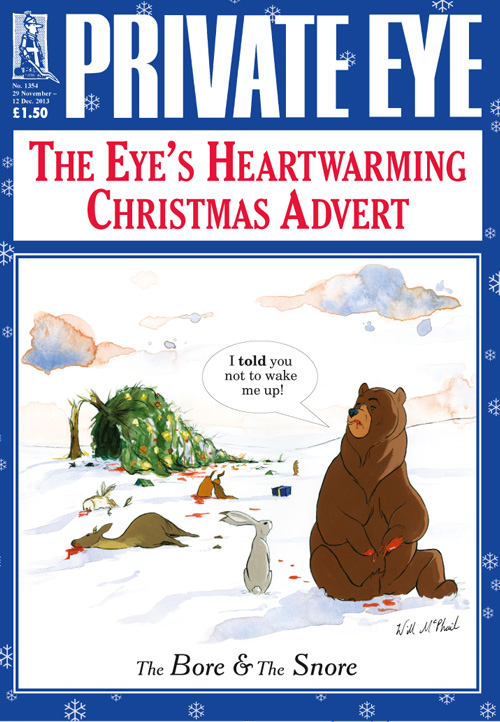
But there's a more important point here. Which has been shown with this year's advert.
This year, we get the complete package. A story that focuses on a young boy and an imaginary penguin (which is actually a stuffed toy). But the penguin is lonely, and wants another penguin to love. The kid buys another penguin for the penguin and presumably spent most of Christmas night banging them together, what with his limited understanding of how penguins procreate. I have to admit, I'm not entirely sure how penguins bang either, and have no desire to have that on my Google search history. Incidentally, since the kid's dad isn't in the advert, I'm entirely fine with the suggestion that the penguin toy is possessed by the ghost of the kid's dead dad.
But why is this important?
Because, similarly to the bear and hare, the penguin (Monty) has his own product range. You can buy plushies of Monty, t-shirts with Monty on, ties with Monty on, cushion covers with Monty on, duvet covers with Monty on. None of them are particularly cheap either.
As of last year, John Lewis moved from the advert being about their catalogue to being about a specific range of products. This is how successful they are. The main Monty items are already sold out, six weeks before Christmas. And in the reviews, someone is talking about how happy they are that they managed to get one, because they weren't able to buy their child the bear and the hare the previous year.
It's nakedly self-serving. It's pushing your emotional buttons in order to sell you a single, along with some plushie toys and duvet covers. They even went so far, this year, as to have the kid being given the plushie this year. It isn't even subtle.
It's part of a new trend, which I think Starbucks kicked off with their red cups. Corporate Christmas traditions. At least the red cups thing has finally backfired as just about every other coffee chain have realised that Starbucks don't own the colour red and have started doing the same thing at Christmas. Which means it's backfired a bit, which I'm delighted about.
But this is what adverts do. Cheaply and manipulatively try to take parts of Christmas and brand them.
And it works. We lap it up. The John Lewis advert has been an enormous hit, and what they're out to sell has sold out in the thousands.
But it's been beaten by the Sainsbury's advert, which retells the Christmas truce. This, for me, has crossed the line, and I think we need to talk about what's acceptable to use when you're manipulating people's emotions in the name of profit.
How did this come up in the first place? How did this idea first get floated and approved? I imagine the conversation in their PR team went a little like this:
"John, we need to come up with something to get more customers in the store, ever since we accidentally told everyone that we were trying to squeeze an extra fifty pence out of them."
"It's a tough one. Coming up with sentimental Christmas stuff isn't easy."
"Too true. I've heard that John Lewis are going with a lonely, blue-balled imaginary penguin."
"They must be completely out of ideas."
"I totally agree."
"If only we could use something truly touching."
"You mean like the Christmas truce in the first world war?"
"Yeah, something like that. A moment of humanity in the middle of a senseless war that caused so many millions of deaths. A moment that shows how we're all the same, even at our worst moments."
"So how do we take something like that and use it to make people spend money in our shop?"
"Steve, you don't think that could be a bit unpleasant, do you?"
"You're right. We'll leave out the death bit. Chuck in a robin. And give the Royal Legion a call so we can make out we're doing it out of Christmas spirit."
"Happy December Profits, John!"
I may be abridging it slightly, but I honestly think the conversation must have been at least a bit like that. Somewhere, some people around a table decided that the WWI Christmas truce was an appropriate point in history to exploit for an advert and they made sure there was a charity angle in there in case they were criticised. This will have been proposed, approved, written, tweaked, designed, tweaked, retweaked and finally given the green light to be filmed.
Fine, the profits from the chocolate bar go to the Royal Legion. That's a good thing. But let's not pretend it's being done purely out of charitable impulse. It's about increasing footfall. It's about getting people into the shop and getting them to buy more things than that single item.
That's why the advert exists. That's the point of it. That's the point of the chocolate bar.
This hasn't been done out of any cosy Christmas feelings. This has been done to exploit cosy Christmas feelings. Personally, I love Christmas, even as an atheist. I tend to go to Ireland and spend time with my family. I'm even into corny sentimentality - you're looking at one of the few people who liked the remake of Christmas on 34th Street. But I'm not into serious attempts to get me into your fucking shop.
What John Lewis have started with their mini Christmas movies is an attempt to corporatise a season. And it's become competitive. Everyone will, next year, be looking to see what Sainsbury's do, and if you think that all the other brands haven't noticed the press that John Lewis and Sainsbury's have had over these two mini-movies, then you'll be surprised just how many go for the emotion button next year, and what they're willing to do in order to achieve it.
If we're okay with an incident in the middle of the deaths of millions being used to get us into shops, then what are we not okay with?
Sunday, 26 October 2014
The time I saw a UFO
 |
| Starry night (source) |
I saw a UFO once.
It still feels like a strange sentence to write down, and I daresay some of you reading it will have had a reaction to me saying it. Please allow me to tell my story before you make any judgements.
It was a long time ago, and I was a different person then. I was at university and me and my then-girlfriend had a long and awkward commute between the university itself (in West Yorkshire) and where we were living at the time (in North Yorkshire). She'd drive, as I hadn't learned to yet, and I'd sit in the passenger seat during the early hours of the morning as we made our way through dark B-roads (which we sometimes took to avoid traffic jams on the motorway). We'd talk, listen to music and generally try to keep each other entertained and awake. I found the journeys hard going and I was just in the passenger seat - I can't imagine how difficult it must have been for her.
You'd occasionally see odd and interesting things as you drove through the countryside. One time, we pulled over during the daytime, because there were enormous flocks of birds flying and creating an enormous billowing flurrying sheet of movement, and you could see the ripples of the shape they created as they moved together. Walking out into the field to watch, it felt mystical, primal and powerful to see them intersecting in complicated patterns.
This time, though, it was the early hours of the morning at some point in 1999 or early 2000 (I remember the details far more vividly than the generalities). We were driving home on a clear night. While there are fifteen years or thereabouts of memories in the way, I'm fairly confident I can say that I was either as sober as her or at least only marginally less so, and that we weren't particularly more tired than we normally would be on that route.
We saw a light in the sky. It was larger than a star, but very bright. It looked brighter than an aircraft light (which was our first assumption) and very focused. I remember thinking of it as looking like a searchlight from a helicopter, but from much further away and without the beam of light coming down from it.
It moved in very straight lines across our field of vision, and then would turn at acute angles and travel in another straight line, before turning again. Considering how far away the light seemed, it was covering an amazing amount of distance in a short amount of time. I'd say at least twice as fast as watching a passenger plane going across the same distance. We were confused and intrigued, so we pulled over and got out of the car to watch.
Then it was joined by another light, and a third after a while. All three of them would move in straight lines and turn sharp corners. They weren't quite in formation, but they all seemed to have their own vague patterns. They weren't quite drawing triangles in the sky, but if you think of them all doing that, you won't be far off what we were looking at. The three of them moved independently.
After a while of watching (probably about five minutes or so), we got back into the car and continued on our journey.
What happened next was frightening.
After a short while on these quiet roads, we started being followed by a light. It was rectangular, and looked a bit like a motorcycle headlight, if a bit larger. It was at roughly the right height for it as well, so we didn't think too much of it at first. It was just very bright.
As it got closer, it was actually lighting the road ahead of us to the point where we could have turned off the car headlights and safely continued to drive. And this wasn't even with it immediately behind us - it was still a few car's distance behind. But it was following us for a while.
I was looking behind us and watching the light as my girlfriend drove. We'd just seen something strange in the sky, so we were both aware that we were likely just a bit paranoid and weirded out. It was probably just a motorbike with its headlights on full beam.
We were driving a bit below the speed limit, so we weren't going overly quickly, but we certainly weren't crawling either. So I was watching to confirm that it was a motorbike. As we took a fairly sharp corner, I watched the light carefully - at the speed we were going, it would have had to lean into the corner, so the rectangular shape I could see would have to lean in as well.
It didn't. While we lost the light for a moment, as the corner was between us and it, when it came around the corner, that light was steady and at exactly the same angle.
We took another corner, and it stopped following us. The light was gone.
That was the last unusual thing we saw that night. We talked about it for a while and agreed we couldn't explain it. My memory is that we were both a bit frightened by it all.
But it wasn't a defining moment for us. We went back to university and work and got on with our lives. We split up a while later - I was 20 years old and, through a combination of emotional immaturity, selfishness and a lack of understanding, wasn't very good at being a boyfriend, so she quite sensibly ended things.
All of the above has been told as consistently and as fairly as I can. Fifteen years of memories cloud things. It's entirely my memory of it as well - while I've said 'we' throughout, it's purely to avoid complicating the story. I don't remember any specifics of the conversations that we had about it at the time, and who said or did what, and we're not in touch any more (and while I hope that she's doing well, I rather doubt either of us is racing to fix that - we've both moved on with our lives), so you'll have to take my word for it all. But it's as clear a memory as I have of it, and the details I've described remain vivid.
So, it was completely unexplained. The bright lights in the sky, moving in a completely unnatural way, and then the floating light following us.
But.
But, but, but.
Unexplained does not mean the same thing as inexplicable.
The reason I haven't spoken publicly about this for fifteen years isn't because I'm embarrassed about it - it's because I didn't understand it. However, now, I think it makes more sense, and can be explained. Which is why I'm more comfortable talking about it.
And it's a fairly simple, mundane explanation, all things considered. But it's still plenty intriguing.
The first thing to point out is that the area we were travelling in wasn't just countryside. We weren't particularly far away from Menwith Hill, an RAF base that also happens to be the area where project ECHELON is located. Here's the wikipedia page, and also, because I'm a fan of coincidences, here's a link to an article written for Esquire back in 2000 by an investigative journalist called Eamonn O'Neill about ECHELON. The coincidence here is that Eamonn, now a professor of investigative journalism, is my uncle.
A good few years later, I told this story to a friend of mine who pointed out that there was a very simple explanation for the floating light behind us (and some of you reading this may have already worked it out).
It was most likely a jeep with a searchlight. That's why it was so bright and, when we took the corner, why it remained steady - because it was travelling on four wheels, and staying steady the same way we were. And why did it vanish suddenly? It just got switched off. It actually sounded obvious once it was pointed out. But because I'd thought of it as 'like a motorcycle headlight' and the most confusing feature was that 'it didn't move like a motorcycle', I had difficulty rethinking it.
So, the story goes from being 'we saw something mysterious and alien and something mysterious and alien followed us' and becomes rather more 'we saw something'.
So, taking the large light near the ground out of the equation, the mystery remains around the three lights moving in straight lines and sharp angles.
I reckon, looking back, what we saw were drones. Early ones, in development ones, or even just a demonstration of how they worked. It's a base that specialises in surveillance, after all.
This, to me, explains everything. The lights weren't quite as high up as we thought they were - they were just very small, so we thought we were looking at something larger, further away. Why were they flying in strange straight lines and sharp angles? Because they're multi-directional and remote controlled. That's how they work.
At which point, I reckon the whole thing becomes a rather more harmless story. Assuming that they were drones, it's not unreasonable to guess that they were either broadcasting night vision or heat signatures or something similar, and we were seen nearby watching them. At which point, they send someone with a jeep to check us out, either to check we're not spies or (more likely) to confirm that 'yep, that was a person and we're interpreting what we're seeing correctly'.
While I love stories about close encounters and aliens, and while I love conspiracy stories, I love actual explanations more.
The dark late night, the strange lights and being followed. It has all the hallmarks of the kind of unexplained story that appeals, but there's plenty of room for explanations.
When we tell a story, we have our own natural bias in it. It's easy to assume that, because we don't know what the motivations are for the other people involved, that they can only be one thing. It's easy to assume that, because we don't understand something, that it must be something sinister or enormous.
Conspiracy theories, whether they're the kind that suggest that the government knows that aliens exist, or the kind that suggest that the illuminati planned 9/11 in order to instigate worldwide war, are attractive because they not only explain that there's a reason for certain events, but they also describe a world where there's a reason that we don't know things. Why aren't we successful? Because there are secrets to being successful that we aren't told. Why aren't we told how the world works? Because the evil forces that manipulate it want to keep it the way that it is. Explanations like this can be a lot more comforting than the idea that we're not successful because we're not good enough or don't work hard enough, or that we don't know how the world works because we're not smart enough or haven't looked carefully enough (or even that there are societal issues involved, which are a whole other area, but still...).
While I believe that there's probably life out there somewhere, I don't particularly believe in government conspiracies regarding them - to put it simply, I don't actually believe they're competent enough to have kept something like that under wraps.
Actual explanations for things that are simpler and more mundane may be less exciting, but I love them. They say so much more about how we interpret things and about how we try to solve things. I love the idea that we were followed because they wanted to check their new toy was working properly so much. It feels human and real to me, and it satisfies me so much more than anything else.
So, that's my UFO story. Does my explanation make sense? Let me know in the comments.
While I may not believe in conspiracy stories, I do enjoy writing about them. Please check out my new book, Deadlines. It's a crime/conspiracy thriller that's being published in 10 parts by The Pigeonhole at 50p per instalment. It's a little bit Lois Lane, a little bit The Girl With The Dragon Tattoo and a little bit Watergate.
Here's what some people are saying about it on the Pigeonhole message board:
"Loved stave 1, the idea and characters are great. I think your analogy of thinking of this like a weekly TV murder mystery is spot on (State of Play springs to mind)." (Graeme Langlands)
"I like this a lot a lot. Nearly knocked a cyclist off his bike wombling about reading it on my way into work, so engrossed was I. Can't wait till next week!" (Sarah Larkin)
"Good start and I'm looking forward to more. I get a Stieg Larsson-esque in London feel from it" (William Paul Boyce)
Deadlines - Sometimes, getting the story can be murder.
Saturday, 11 October 2014
DEADLINES - all about my new book
 |
| DEADLINES - out on Wednesday! |
DEADLINES is a crime thriller and is my first full-length novel. It will be published in 10 parts over at www.thepigeonhole.com starting on Wednesday 15 October.
What's the story about?
Two reporters at The Sentinel newspaper, Gemma Masterton and David Levy, investigate the suspicious death of a colleague and begin to uncover something large, complicated and dangerous. As events spiral out of control, their lives are put in danger.
How often do the parts come out?
They come out every Wednesday for ten weeks, starting on 14 October. You also get some free bonus material with each stave.
What's a 'stave'?
The sections of the novel are called 'Staves', which is what they were called back when novels were published serially in Victorian times.
What kind of bonus material?
A mixture of things. The Pigeonhole have taken a fun, innovative approach. There are photos, social media tie-ins, essays, music playlists, video interviews and podcasts.
What do other people think about The Pigeonhole?
Well, here's just some of the coverage:
“The app's minimalist design is superb – I haven't enjoyed reading on my phone until now”
“Hurrah for The Pigeonhole”
“Now, after a century of neglect, the art of the cliffhanger is experiencing a revival”
So, how will it work?
If you have an iPhone, there's an app which makes it insanely easy to read both the novel and the bonus material. If you don't, you can read both on their website which is also optimised for mobiles and tablets. You can also download the novel for the Kindle as well. So, basically, if you can read this, you can read DEADLINES.
How much is it?
50p per stave. You pay at the end, and if you decide it's not for you, you can cancel during it and only pay for the parts you've subscribed to.
Why is it being published serially?
Because serial stories are a huge amount of fun. Look at TV - Mad Men, Breaking Bad, The Killing, Broadchurch... shows like this are partially fun because they keep you waiting to see what will happen, in a sort of sweet torture, especially after particularly evil cliffhangers. And as the book goes on, there are some very evil cliffhangers.
What if I join in while it's in progress?
Yes. You can buy all the previous staves at any point.
Will it be coming out in print?
It might do eventually. The best way to ensure that it'll come out in print is to support the serialisation. So, if you're interested, please do sign up.
What else does The Pigeonhole offer?
Well, you can get involved in discussions about the book, as there's a discussion area. There are also four other books available, including WISDOM HACKERS (a non-fiction series), SEX STAVES (erotic short stories), GREAT EXPECTATIONS (the Dickens story, which was originally published serially) and REDPOINT (which has already been completed).
How do I subscribe?
Go to www.thepigeonhole.com and sign up to the site for free. Once you've joined (and possibly downloaded the app, if you're so inclined), you can subscribe to DEADLINES. Please note, you will need to subscribe once you've joined.
How do you feel about it?
Nervous and excited. Getting reactions as it goes through is both something I'm looking forward to and something I'm terrified of. But I think the Pigeonhole is doing something that's so much fun, I'm incredibly excited and honoured to be part of their launch lineup. So, please, do get involved.
Tuesday, 23 September 2014
Stories are important
Stories are important.
When we're learning to process thoughts and words in the first place, we learn through stories. When we're learning right and wrong, we learn through stories.
They form us and they inform us.
And when we're children, as any parent knows, we cling to our stories and we want to hear them again and again and again and again and again and again and again and again and again and...
When we grow up, we start to create our own stories. We cast ourselves as the main characters and we craft our own story as we live our life. We sometimes spend a long time trying to work out who that character is. But we keep on with the stories anyway.
Sometimes, we tell stories about other people. Sometimes, we realise we're part of someone else's story. Sometimes we realise there are more stories than we can count.
And in the meantime, we tell each other stories. We speak them. We write them.
Funny stories. Sad stories. Personal stories. Scary stories. Bad stories. Good stories. Exciting stories. Beautiful stories.
We go and watch stories. We buy books so we can read stories. And we use technology to find new stories. We read stories in new ways. We listen to stories and we want our stories to be listened to.
We learn about each other through stories. We learn about the world with stories.
We start off making sense of life with stories and we end up making sense of our lives with stories.
When we're learning to process thoughts and words in the first place, we learn through stories. When we're learning right and wrong, we learn through stories.
They form us and they inform us.
And when we're children, as any parent knows, we cling to our stories and we want to hear them again and again and again and again and again and again and again and again and again and...
When we grow up, we start to create our own stories. We cast ourselves as the main characters and we craft our own story as we live our life. We sometimes spend a long time trying to work out who that character is. But we keep on with the stories anyway.
Sometimes, we tell stories about other people. Sometimes, we realise we're part of someone else's story. Sometimes we realise there are more stories than we can count.
And in the meantime, we tell each other stories. We speak them. We write them.
Funny stories. Sad stories. Personal stories. Scary stories. Bad stories. Good stories. Exciting stories. Beautiful stories.
We go and watch stories. We buy books so we can read stories. And we use technology to find new stories. We read stories in new ways. We listen to stories and we want our stories to be listened to.
We learn about each other through stories. We learn about the world with stories.
We start off making sense of life with stories and we end up making sense of our lives with stories.
Subscribe to:
Posts (Atom)