I find London fascinating. Except for a brief period, I've been living here since 2002. And I do love it.
I have some ideas for something that I'm going to write about London, but I need to get some thoughts down and in order before I do. I don't quite have it yet. I need to do some working out.
So, that's what this is going to be. Some thoughts, observations and flights of fancy about this city and the stories in it. Occasional posts, just seeing how my brain works when I'm thinking about the place. It's going to be a little bit stream-of-conscious, but there'll usually be something I'm struggling towards. And maybe sometimes, I'll find it.
Following a talk I went to earlier tonight, I got to wondering about the links between London and horror stories. And it led to me thinking about whether there has ever been a series of macabre stories as influential and intense about a place as there was in London at the tail end of the 19th Century? Following on from A Christmas Carol earlier in the century (which, along with Dickens' other work, painted a picture of London covered in snow at Christmas that has stayed in culture's heads since), we saw the stories of Sherlock Holmes, Dracula and Doctor Jekyll and Mr Hyde. And around the same time, we also saw that reality could be just as macabre with the murders of Jack the Ripper.
That leads to a sense of London being a scary place, with death around every corner. I find it interesting that Holmes, Jekyll and Hyde and Dracula were written by people who moved to London - two Scots and one Irish. There's an element of London being described by intepretation.
And I think that London has to be interpreted. It's a city that almost defies understanding, with it's incredible, intricate history of smaller areas joining together, each with their own individual culture and background, as complicated as the roadmap. It's constantly changing, often in front of your eyes as you walk down one part or another and suddenly an entire block has been torn down. It can be difficult to get a concrete idea of sometimes, because it keeps changing.
London is very vital. It's very of the moment, because occasionally you'll look around an area and realise just how much it's changed over a few years. And it does change. One of the things I find fascinating about London is how much of it has been lost. There's still plenty there, obviously, but there are bits that have been lost over the years, between fires, plagues, bombs and development. Identities of areas change, sometimes for the better, sometimes not.
But the past remains. It's burned into the city. The stories are there, planting this idea of London into people's heads. And the fact that the city has changed so much somehow makes it only more real. It's not past that we can see and hold and touch. It's past that exists more in the realm of story. Of myth. Of legend. A London that exists with some foundations in the ground, and other foundations buried deep in the memory... the personal memory and the cultural.
The London of the real and the London of the stories.
And somehow, it's all the same London.
Tuesday, 28 April 2015

Saturday, 18 April 2015
What you learn about content by dying in stand-up comedy
The importance of being misunderstood
 Doing stand-up comedy is a great learning experience. One that I'd recommend to anyone in content, marketing or communications. But I wouldn't recommend it because of what you learn from doing it well.
It's because of what you learn when it goes badly.
Comedians refer to it as 'dying'. And it's pretty apt. The first time I performed a routine that absolutely died in front of an attentive audience, it was like time slowed down and I was looking out at a growing chasm between me and the light at the back of the room.
It's odd, especially if you're used to doing reasonably well. The first time it happens, your response while it's happening is utter confusion. You had them a moment ago, but something disconnected and stopped working. You assume, at first, that a single punchline work, but then the next one doesn't work. Briefly, you might assume that you've briefly forgotten how to speak English. And, worse, you still have to keep going, because you don't want to walk off-stage and give in. So you try everything you can, and you try to get them back. Sometimes it even works.
You often hear about comedians blaming the audience. "They weren't listening." "It was just the wrong room." "They didn't get what I was trying to do." And sometimes it is their fault. But most of the the time, it isn't. It's your fault.
And this is where it becomes useful from a content point of view.
Content is all about communication. Taking a product, service, idea or message and explaining it to an audience. If you explain it well and the product is good (or even if it isn't, sometimes), the audience will respond. If you don't, they won't.
Let's take a hypothetical. Johnny's tasked with selling a new perfume. He can see the idea in his head clearly, and he's worked on it. He's got the story, the message, the core of the idea and it all makes sense from beginning to end. And the distribution is good. But once it's out, it just doesn't connect at all with an audience. The next day, Johnny realises he has mysterious powers and becomes a supervillain because of his anger at his failure. Obviously, this has to be avoided.
My belief is that a lot of the time, this happens because the person or people behind the message haven't been able to make the leap between what they think works and what actually connects with the audience.
Often, this happens because of ego. Someone thinks the way they've defined something is the right way for it to happen. And that's understandable - when it works for you, it works for you, and it isn't necessarily intuitive that it only works for you. Or it may be that you've left out an important part of the information at some point during the process, and without it, it doesn't fully make sense. And because everyone involved in the process knows the information, they don't realise. Or sometimes, you just become so bogged down in the whole process and so many people get involved that you stop seeing the wood for the trees.
With comedy, you're getting instant feedback. If what you've got doesn't work, there aren't too many ways to deny it. You can have put together something that you absolutely love and find absolutely hilarious, but it just doesn't connect.
At that point, where you learn is when you start to try to work out why you didn't connect. When you look at it from the audience's point of view and try to figure out what caused the gap.
That first time I died, it was because I'd assumed the audience had information that I had. I missed it out, so the basic context for the routine didn't connect and the routine didn't work.
You can't force something to work. But you can fix something, assuming the basic idea actually works. You have to listen and react to feedback. And, ideally, you have to get that feedback before what you're working on goes out to an audience.
It's no coincidence that the best writers I know never assume they've got it right first time out. They look for feedback, assuming that it's probably broken in some way that they can't see, and they look for fresh pairs of eyes on it, to make sure they're not assuming knowledge.
And it's no coincidence that the best comedians I know listen to their audiences, working out what connects and what doesn't. They test and test and test.
You may be good at communicating, but it really is worth trying some stand-up at some point. Can you communicate what you think is funny in a way that other people will find funny?
When you stand in front of a room full of strangers, with no real way to spin the results, trust me. You'll know if you're not communicating.
It's because of what you learn when it goes badly.
Comedians refer to it as 'dying'. And it's pretty apt. The first time I performed a routine that absolutely died in front of an attentive audience, it was like time slowed down and I was looking out at a growing chasm between me and the light at the back of the room.
It's odd, especially if you're used to doing reasonably well. The first time it happens, your response while it's happening is utter confusion. You had them a moment ago, but something disconnected and stopped working. You assume, at first, that a single punchline work, but then the next one doesn't work. Briefly, you might assume that you've briefly forgotten how to speak English. And, worse, you still have to keep going, because you don't want to walk off-stage and give in. So you try everything you can, and you try to get them back. Sometimes it even works.
You often hear about comedians blaming the audience. "They weren't listening." "It was just the wrong room." "They didn't get what I was trying to do." And sometimes it is their fault. But most of the the time, it isn't. It's your fault.
And this is where it becomes useful from a content point of view.
Content is all about communication. Taking a product, service, idea or message and explaining it to an audience. If you explain it well and the product is good (or even if it isn't, sometimes), the audience will respond. If you don't, they won't.
Let's take a hypothetical. Johnny's tasked with selling a new perfume. He can see the idea in his head clearly, and he's worked on it. He's got the story, the message, the core of the idea and it all makes sense from beginning to end. And the distribution is good. But once it's out, it just doesn't connect at all with an audience. The next day, Johnny realises he has mysterious powers and becomes a supervillain because of his anger at his failure. Obviously, this has to be avoided.
My belief is that a lot of the time, this happens because the person or people behind the message haven't been able to make the leap between what they think works and what actually connects with the audience.
Often, this happens because of ego. Someone thinks the way they've defined something is the right way for it to happen. And that's understandable - when it works for you, it works for you, and it isn't necessarily intuitive that it only works for you. Or it may be that you've left out an important part of the information at some point during the process, and without it, it doesn't fully make sense. And because everyone involved in the process knows the information, they don't realise. Or sometimes, you just become so bogged down in the whole process and so many people get involved that you stop seeing the wood for the trees.
With comedy, you're getting instant feedback. If what you've got doesn't work, there aren't too many ways to deny it. You can have put together something that you absolutely love and find absolutely hilarious, but it just doesn't connect.
At that point, where you learn is when you start to try to work out why you didn't connect. When you look at it from the audience's point of view and try to figure out what caused the gap.
That first time I died, it was because I'd assumed the audience had information that I had. I missed it out, so the basic context for the routine didn't connect and the routine didn't work.
You can't force something to work. But you can fix something, assuming the basic idea actually works. You have to listen and react to feedback. And, ideally, you have to get that feedback before what you're working on goes out to an audience.
It's no coincidence that the best writers I know never assume they've got it right first time out. They look for feedback, assuming that it's probably broken in some way that they can't see, and they look for fresh pairs of eyes on it, to make sure they're not assuming knowledge.
And it's no coincidence that the best comedians I know listen to their audiences, working out what connects and what doesn't. They test and test and test.
You may be good at communicating, but it really is worth trying some stand-up at some point. Can you communicate what you think is funny in a way that other people will find funny?
When you stand in front of a room full of strangers, with no real way to spin the results, trust me. You'll know if you're not communicating.
Sunday, 12 April 2015
Writing when burnt out
For the last few months, I've been finding it difficult to write. It's been for a whole bunch of reasons, including a very busy period before Christmas and finally coming to the end of a few long-term issues and stresses, some of which went on for years. Once it was all done, I deflated a bit. And I've found getting my energy back difficult.
And I'm the kind of person that withdraws when they feel like that. That doesn't want anyone to pay attention to me. That just wants to burrow away and not deal with anybody or anything.
These are not ideal conditions for writing. And I strongly suspect that I'm far from alone in going through periods where I feel like this. So I thought I'd explore it a little.
Part of it is that putting your writing out there is an exposing thing to do. You're taking something that is very personal and letting people see what they think of it. This writing thing, it's a compulsion. A secretive, furtive thing, that you can't really do as a social activity. Most of it is done on your own, quietly. And like most furtive, secretive things, sharing it with an audience can feel a little exposing.
But you'll have people you can share with. When you start writing, that's a very small group. Perhaps some family. Perhaps some friends. And you're probably looking for some element of validation. "Can I actually do this?"
That's a scary thing to do. And taking the steps towards trying to get published, whether in short or long form, are scary as well. You have to take this personal thing, that you're very close to, and ask other people to judge it. Magazine editors. Website owners. Agents. Publishers. And with the awareness that they may even want to tell you what they think. They may love it. But they may hate it. And, even worse, they may tell you why. And even worse, you may agree with them.
It's tempting to keep it to yourself. But the longer you do that, the more personal it becomes. The more private it becomes. And so the more difficult it becomes to expose to the light and share with other people. It's one of the reasons I've set up writing groups, and run the one I'm currently part of for the last four years. Talking to people about your writing, and sharing it in a safe environment is a good way to get over some of those nerves. Because if you want to be a writer, it involves people reading your work.
Being published is exposure. Both in a good and a bad way. You're putting yourself out there in front of people. People who know you, people that remember you, people that like you, people that don't like you. You can't pick and choose - that's part of the point. And once it's done, once it's out there... it's out there. There's no going back.
That's good, I think. A writing career, I believe, is all about building. It's all about building your confidence, building your profile, building your audience and maybe even building your income. You get better at writing by writing.
If you don't put your work out there, it's difficult to get better. You have to expose it to the light and see what people think of it. Sometimes they'll like it. Sometimes they won't. But if it's going to be something that's real, that's going to live and breathe, it has to stop being in your head, and has to stop being something that you just endlessly polish and polish and polish. Sometimes, it's got to be tested.
At this point in time, I've had a few things published and began to see some success in terms of response. Some people really liked Deadlines and POV. More, as far as I've seen, than didn't. And that's all good. I enjoyed putting something out there that I made up in my brain-meats and put into words and see if they sank or swam. I tested it. And I'm going to keep testing stuff, not just because I have to, but because I want to.
And getting to the point where I'm comfortable with that isn't easy. I've had to take a couple of steps back and realise that I've been trying to juggle a lot in my life, and trying to do all of them means that I'm not always doing all of them well. I have to occasionally build in some time where I'm not doing anything and it's okay for me not to do anything.
I have the kind of mindset where if I'm not doing something productive, I start feeling guilty. And while that's motivating as hell in a lot of ways, it's also a way that adds a lot of pressure. And when I'm not feeling at my most confident, it's only making me feel worse. And when that happens, not writing makes me feel guilty, which makes me feel more anxious, which makes me less able to write. Not fun.
I'm keeping working on it. I'm working on my next novel, and then I'll look at polishing up the first novel I ever wrote. I'm currently unagented, so I'll be looking for an agent again at some point soon. I'm also writing some comic script and other projects. But I'm not working to a deadline here, and it's important sometimes to remember that feeling like I'm falling behind is a self-imposed deadline.
I'm only going to be able to do it if I shift gears a little. Remembering that if I need to take a little "me" time, that's not going to break me completely. I don't lose the steps I've already completed.
So, if you're feeling in a similar boat, do remember that every now and then, it's okay to just settle back and enjoy the sea. If you're constantly racing and constantly pushing yourself, sometimes you'll burn out a little bit.
You can get it back. Totally (and right now, I'm feeling more like I'm beginning to get back to it). But if you're spiraling, sometimes you need to stop, take stock and make sure you're okay, because otherwise, you're just going to run smack into a wall that stops you for much longer.
Quitting is bad. Don't quit. But stopping to breathe a bit is okay too. You don't stop a panic attack by stressing your way out of it. And you don't go through burn out without needing a little recovery time. But then you start up again and you keep going.
Writing isn't a sprint. It isn't an endurance test. You can get a certain amount of the way through sheer stubbornness, but you need to take care of yourself as well.
But whatever stage you're at in your career, you're going to go through points where you don't feel capable of exposure. Where the idea of sharing your writing would be like sharing your deepest, weirdest, innermost thoughts (or even, gulp, your browser history). There's no superhuman trick to confidence. Even the most talented go through points where they feel like they're idiots who shouldn't be allowed crayon in case they accidentally write something somewhere.
So, realistically, you're probably going to feel like this at some point. You may feel like it more often, you may feel like it less often. You may feel like it most of the time.
But it passes. Being a writer means veering wildly between embarrassing amounts of ego and crippling self-doubt. Take a bit of time. Breathe. Remember why you're doing what you're doing.
And then get back to it.
And I'm the kind of person that withdraws when they feel like that. That doesn't want anyone to pay attention to me. That just wants to burrow away and not deal with anybody or anything.
These are not ideal conditions for writing. And I strongly suspect that I'm far from alone in going through periods where I feel like this. So I thought I'd explore it a little.
Part of it is that putting your writing out there is an exposing thing to do. You're taking something that is very personal and letting people see what they think of it. This writing thing, it's a compulsion. A secretive, furtive thing, that you can't really do as a social activity. Most of it is done on your own, quietly. And like most furtive, secretive things, sharing it with an audience can feel a little exposing.
But you'll have people you can share with. When you start writing, that's a very small group. Perhaps some family. Perhaps some friends. And you're probably looking for some element of validation. "Can I actually do this?"
That's a scary thing to do. And taking the steps towards trying to get published, whether in short or long form, are scary as well. You have to take this personal thing, that you're very close to, and ask other people to judge it. Magazine editors. Website owners. Agents. Publishers. And with the awareness that they may even want to tell you what they think. They may love it. But they may hate it. And, even worse, they may tell you why. And even worse, you may agree with them.
It's tempting to keep it to yourself. But the longer you do that, the more personal it becomes. The more private it becomes. And so the more difficult it becomes to expose to the light and share with other people. It's one of the reasons I've set up writing groups, and run the one I'm currently part of for the last four years. Talking to people about your writing, and sharing it in a safe environment is a good way to get over some of those nerves. Because if you want to be a writer, it involves people reading your work.
Being published is exposure. Both in a good and a bad way. You're putting yourself out there in front of people. People who know you, people that remember you, people that like you, people that don't like you. You can't pick and choose - that's part of the point. And once it's done, once it's out there... it's out there. There's no going back.
That's good, I think. A writing career, I believe, is all about building. It's all about building your confidence, building your profile, building your audience and maybe even building your income. You get better at writing by writing.
If you don't put your work out there, it's difficult to get better. You have to expose it to the light and see what people think of it. Sometimes they'll like it. Sometimes they won't. But if it's going to be something that's real, that's going to live and breathe, it has to stop being in your head, and has to stop being something that you just endlessly polish and polish and polish. Sometimes, it's got to be tested.
At this point in time, I've had a few things published and began to see some success in terms of response. Some people really liked Deadlines and POV. More, as far as I've seen, than didn't. And that's all good. I enjoyed putting something out there that I made up in my brain-meats and put into words and see if they sank or swam. I tested it. And I'm going to keep testing stuff, not just because I have to, but because I want to.
And getting to the point where I'm comfortable with that isn't easy. I've had to take a couple of steps back and realise that I've been trying to juggle a lot in my life, and trying to do all of them means that I'm not always doing all of them well. I have to occasionally build in some time where I'm not doing anything and it's okay for me not to do anything.
I have the kind of mindset where if I'm not doing something productive, I start feeling guilty. And while that's motivating as hell in a lot of ways, it's also a way that adds a lot of pressure. And when I'm not feeling at my most confident, it's only making me feel worse. And when that happens, not writing makes me feel guilty, which makes me feel more anxious, which makes me less able to write. Not fun.
I'm keeping working on it. I'm working on my next novel, and then I'll look at polishing up the first novel I ever wrote. I'm currently unagented, so I'll be looking for an agent again at some point soon. I'm also writing some comic script and other projects. But I'm not working to a deadline here, and it's important sometimes to remember that feeling like I'm falling behind is a self-imposed deadline.
I'm only going to be able to do it if I shift gears a little. Remembering that if I need to take a little "me" time, that's not going to break me completely. I don't lose the steps I've already completed.
So, if you're feeling in a similar boat, do remember that every now and then, it's okay to just settle back and enjoy the sea. If you're constantly racing and constantly pushing yourself, sometimes you'll burn out a little bit.
You can get it back. Totally (and right now, I'm feeling more like I'm beginning to get back to it). But if you're spiraling, sometimes you need to stop, take stock and make sure you're okay, because otherwise, you're just going to run smack into a wall that stops you for much longer.
Quitting is bad. Don't quit. But stopping to breathe a bit is okay too. You don't stop a panic attack by stressing your way out of it. And you don't go through burn out without needing a little recovery time. But then you start up again and you keep going.
Writing isn't a sprint. It isn't an endurance test. You can get a certain amount of the way through sheer stubbornness, but you need to take care of yourself as well.
But whatever stage you're at in your career, you're going to go through points where you don't feel capable of exposure. Where the idea of sharing your writing would be like sharing your deepest, weirdest, innermost thoughts (or even, gulp, your browser history). There's no superhuman trick to confidence. Even the most talented go through points where they feel like they're idiots who shouldn't be allowed crayon in case they accidentally write something somewhere.
So, realistically, you're probably going to feel like this at some point. You may feel like it more often, you may feel like it less often. You may feel like it most of the time.
But it passes. Being a writer means veering wildly between embarrassing amounts of ego and crippling self-doubt. Take a bit of time. Breathe. Remember why you're doing what you're doing.
And then get back to it.
Saturday, 7 February 2015
Why can't we have a bookshow?
There's been some talk recently about the lack of book coverage on television, following a speech by Robert Harris in which he described it as 'a disgrace'. This was followed by conversation on the #bookshow hashtag on twitter, struck up by @alisonbarrow. And it's something that's been stuck in my head since then.
I don't think the lack of a major book show is a disgrace by any means.
It's just baffling.
There seems to be an attitude that such a thing can't work. That there isn't the interest. And I don't get that. We're raised on stories. We learn to interact and communicate through stories. We create stories, we consume stories, we live and breathe on stories. And one of the ways in which we do this the most is through books.
I can understand that the physical item of a book may not be the most visually exciting thing to look at. Even filled with great, vibrant and exciting art, it's still static. But the stories that those books contain aren't static. They're vibrant and filled with imagination. There are things there that can be visually interesting, and even if not, books, writers and readers are about people. And people can be interesting.
Books are also popular. Writers are popular. Look at twitter and tumblr, and whatever social media anybody who is under the age of 23 (and thus I don't understand yet) uses. You'll find enthusiasm. Wonderful, vital enthusiasm. The kind of enthusiasm that gets behind shows and the kind of enthusiasm that's crying out to be tapped into.
A lot of it is because the idea of a book show has a perception problem. I've seen various shows throughout the years, and none of them have really stuck with me. Fairly or unfairly, the perception I have of them (and I strongly suspect that I'm not alone in this) is that they're for and by critics, rather than readers. Static, uneventful television. And I do think this is a problem.
For a book show to work, it has to be mass market. It has to be aimed at as many people as it can. And while criticism is, obviously, going to be a part of a book show, it shouldn't be the primary focus. Otherwise, it can feel like the kind of show that tells you what you should be reading, and why it's good for you, rather than a show that looks at what you are reading. It shouldn't feel like homework. It should feel like it's listening.
One of the most interesting things about the book industry is what it shares with the movie industry. It's trying to guess what will connect with people and what they'll buy and what they'll love.
A book show should look at that. That should be its primary focus. Not 'what is good?'. Instead, 'what will connect?'
It shouldn't look down on its audience. One of the main things that I feel when I think about past book shows is that they've generally been a bit snobbish, likely to only talk about something overtly mainstream when it's too big to ignore.
Bollocks to that, frankly.
I want a book show that talks about the issues of the day, and talks about them with interest. I don't want a show that would only consider sci-fi, fantasy or horror if people are queuing up at midnight for the latest JK Rowling or George RR Martin book. I don't want a book that sneers at 50 Shades of Grey, but rather one that looks into why it's popular and why it's connecting with so many people - and ideally, I want a book show that looks seriously into whether something like 50 Shades is harmless smut or unintentionally glorifying abuse. Because they're the conversations I see every day online, and they're the conversations that I see so much passion about. So it should look at genres. I don't want to feel like there's 'high' and 'low' literature. I want it to be about stories.
A book show should, completely, be inclusive and safe for as many people as possible. It should reach out. If it's by and for a bunch of straight, cis, white men, then it's going to dead in the water. And the presenters should reflect that.
So, what would I want to see in an actual show? I'd want it to be like a magazine show, with sections. Not too rigid (one of the problems of 10 O'Clock Live was that carefully sticking to the format got in the way when it started to occasionally get interesting, trying to do too much in one hour), but roughly split into six ten minute sections.
So here are some ideas of what I'd like to see in my ideal book show. With the exception of the first one here, these aren't in a particular order.
1 - News.
This should be at the top of the show. Tell me what's going on in publishing and in books now. Tell me what the people who are making books think is going to be hot. What big authors have books coming out soon? Also, this is where news about books being turned into movies goes.
And yes, films should be part of this. They're visually appealing, and of interest. If we can use a section to turn people onto books that films or TV shows are based on, that's no bad thing.
2 - Interviews.
These should be with writers or actors/directors, etc, assuming they're connected with film versions of books. Whoever it is, there should be a reason they're being interviewed - celebrity involvement is a good thing, but it shouldn't be a case of "finding out what kind of books Gerri Halliwell likes".
3 - Features.
These should be informative and fun, similar to the style of features on 'The Great British Bake-Off'. Warm and enthusiastic looks at classic books, writers, and various aspects of writing and publishing.
4 - Book Club.
This is an interactive element.A schedule of upcoming books to be discussed is released online and promoted on the show - the book club is then held online either via group chat or recorded 60 second reviews. Plus facebook and twitter comments. The best are then shown.
5 - Reviews.
Because yes, these should be part of the show. Just not the focus. Again, the focus should be slightly more on 'will it sell?' rather than 'is it a work of art?', but this section should definitely have a bit of meat in it.
6 - Talking point.
This is an 'issue', of sorts, which could be discussed either with a panel or (depending on the size of the show) with an audience. As with the book club, this could also be interactive, with online opinions Can the film better than the book? Should graphic novels be taken seriously? Should autobiographies be ghostwritten? Are ebooks better or are they killing books?
There's more you could do as well. How about a section with speed-pitching events? Or an ongoing section where writers get their work evaluated by agents and publishers with coaching or representation as a prize, and we get to learn more about the agents and the writers?
I'm not saying that this is the only way a show about books could work. But I do think that this would be a different approach to most of what I've seen in the past - and it's a show I'd be more interested in watching. It may be that it's one which only I'd be interested in, and it just replaces one set of problems with another. I'm just going on the basis that I seem like easy audience for something like this, but I struggle to think of something that's already been out that's grabbed me.
The main thing I'm appealing for is for it to be different. For it not to be people sitting on a sofa discussing the literary merits of critically acclaimed books. Again. I believe there's an enthusiastic audience out there - maybe this can be tapped into.
So how about you? What do you want to see from a bookshow? How would you improve what I've suggested?
I don't think the lack of a major book show is a disgrace by any means.
It's just baffling.
There seems to be an attitude that such a thing can't work. That there isn't the interest. And I don't get that. We're raised on stories. We learn to interact and communicate through stories. We create stories, we consume stories, we live and breathe on stories. And one of the ways in which we do this the most is through books.
I can understand that the physical item of a book may not be the most visually exciting thing to look at. Even filled with great, vibrant and exciting art, it's still static. But the stories that those books contain aren't static. They're vibrant and filled with imagination. There are things there that can be visually interesting, and even if not, books, writers and readers are about people. And people can be interesting.
Books are also popular. Writers are popular. Look at twitter and tumblr, and whatever social media anybody who is under the age of 23 (and thus I don't understand yet) uses. You'll find enthusiasm. Wonderful, vital enthusiasm. The kind of enthusiasm that gets behind shows and the kind of enthusiasm that's crying out to be tapped into.
A lot of it is because the idea of a book show has a perception problem. I've seen various shows throughout the years, and none of them have really stuck with me. Fairly or unfairly, the perception I have of them (and I strongly suspect that I'm not alone in this) is that they're for and by critics, rather than readers. Static, uneventful television. And I do think this is a problem.
For a book show to work, it has to be mass market. It has to be aimed at as many people as it can. And while criticism is, obviously, going to be a part of a book show, it shouldn't be the primary focus. Otherwise, it can feel like the kind of show that tells you what you should be reading, and why it's good for you, rather than a show that looks at what you are reading. It shouldn't feel like homework. It should feel like it's listening.
One of the most interesting things about the book industry is what it shares with the movie industry. It's trying to guess what will connect with people and what they'll buy and what they'll love.
A book show should look at that. That should be its primary focus. Not 'what is good?'. Instead, 'what will connect?'
It shouldn't look down on its audience. One of the main things that I feel when I think about past book shows is that they've generally been a bit snobbish, likely to only talk about something overtly mainstream when it's too big to ignore.
Bollocks to that, frankly.
I want a book show that talks about the issues of the day, and talks about them with interest. I don't want a show that would only consider sci-fi, fantasy or horror if people are queuing up at midnight for the latest JK Rowling or George RR Martin book. I don't want a book that sneers at 50 Shades of Grey, but rather one that looks into why it's popular and why it's connecting with so many people - and ideally, I want a book show that looks seriously into whether something like 50 Shades is harmless smut or unintentionally glorifying abuse. Because they're the conversations I see every day online, and they're the conversations that I see so much passion about. So it should look at genres. I don't want to feel like there's 'high' and 'low' literature. I want it to be about stories.
A book show should, completely, be inclusive and safe for as many people as possible. It should reach out. If it's by and for a bunch of straight, cis, white men, then it's going to dead in the water. And the presenters should reflect that.
So, what would I want to see in an actual show? I'd want it to be like a magazine show, with sections. Not too rigid (one of the problems of 10 O'Clock Live was that carefully sticking to the format got in the way when it started to occasionally get interesting, trying to do too much in one hour), but roughly split into six ten minute sections.
So here are some ideas of what I'd like to see in my ideal book show. With the exception of the first one here, these aren't in a particular order.
1 - News.
This should be at the top of the show. Tell me what's going on in publishing and in books now. Tell me what the people who are making books think is going to be hot. What big authors have books coming out soon? Also, this is where news about books being turned into movies goes.
And yes, films should be part of this. They're visually appealing, and of interest. If we can use a section to turn people onto books that films or TV shows are based on, that's no bad thing.
2 - Interviews.
These should be with writers or actors/directors, etc, assuming they're connected with film versions of books. Whoever it is, there should be a reason they're being interviewed - celebrity involvement is a good thing, but it shouldn't be a case of "finding out what kind of books Gerri Halliwell likes".
3 - Features.
These should be informative and fun, similar to the style of features on 'The Great British Bake-Off'. Warm and enthusiastic looks at classic books, writers, and various aspects of writing and publishing.
4 - Book Club.
This is an interactive element.A schedule of upcoming books to be discussed is released online and promoted on the show - the book club is then held online either via group chat or recorded 60 second reviews. Plus facebook and twitter comments. The best are then shown.
5 - Reviews.
Because yes, these should be part of the show. Just not the focus. Again, the focus should be slightly more on 'will it sell?' rather than 'is it a work of art?', but this section should definitely have a bit of meat in it.
6 - Talking point.
This is an 'issue', of sorts, which could be discussed either with a panel or (depending on the size of the show) with an audience. As with the book club, this could also be interactive, with online opinions Can the film better than the book? Should graphic novels be taken seriously? Should autobiographies be ghostwritten? Are ebooks better or are they killing books?
There's more you could do as well. How about a section with speed-pitching events? Or an ongoing section where writers get their work evaluated by agents and publishers with coaching or representation as a prize, and we get to learn more about the agents and the writers?
I'm not saying that this is the only way a show about books could work. But I do think that this would be a different approach to most of what I've seen in the past - and it's a show I'd be more interested in watching. It may be that it's one which only I'd be interested in, and it just replaces one set of problems with another. I'm just going on the basis that I seem like easy audience for something like this, but I struggle to think of something that's already been out that's grabbed me.
The main thing I'm appealing for is for it to be different. For it not to be people sitting on a sofa discussing the literary merits of critically acclaimed books. Again. I believe there's an enthusiastic audience out there - maybe this can be tapped into.
So how about you? What do you want to see from a bookshow? How would you improve what I've suggested?
Wednesday, 28 January 2015
Ghostbusters III - Quick ideas
I'm massively excited about the new Ghostbusters film. I think it sounds like a great idea, and one that could be really fun. The new cast members are smart, funny women, and that's exactly what they need to be.
For me, the least exciting thing they could do would be to do a straight remake. I'd rather see a continuation from the original, and see how the Ghosbusters world has changed. So here's my idea for a Ghostbusters III that I'd like to see, establishing a new team and continuing the original. It's a very brief idea, written over my lunchtime, with some ideas from @cethanleahy and @daddymightyzim, who I was shooting ideas with over twitter.
Ghostbusters III - Ghostbusters Inc
In the decades since the original Ghostbusters movie, the original team set up Ghostbusters Inc. It's become a franchise, and a successful one. Our new team is the first branch in a new location (possibly Chicago). It should be remembered that Ghostbusters should be, at least a bit, scary. The team bickers but works together.
The founder came up with the idea of setting up the new franchise. She's intelligent, optimistic, and she's a huge fan and advocate for the originals. When they announced franchising, she's worked and worked to be able to set up for this, and she's set up with one of her college buddies, who is a technical genius. Opening this, and being official ghostbusters is something she's wanted all her life. They've finally made it. They hire a capable freelance former bodyguard hardass, and they're assigned a manager by Ghostbusters Inc to train them and keep them on-brand.
So, that's founder, techie, hardass and manager. Each of these will have their own story.
They get their new equipment. The manager trains them, and is - throughout - uber-professional. Techie is surprised it's so old-fashioned. She starts tweaking it almost immediately, and throughout the movie is constantly making improvements (by the end, they'll have totally new equipment that's similar but much more modern).
Peter Venkman turns up to do some motivation. He's now old, rich and lazy. He's more interested in flirting and telling stories than he is in telling them anything useful. He's rambly and a bit sleazy. They're all a bit icked out. For the first time, Founder has a bit of the gloss of her opinions of the originals tarnished a little.
They get their first call - it's tough, but they get through it. Founder realises they're not playing at this. Hardass enjoys it. Techie's equipment is playing up. She starts improving it.
Ray Stantz turns up to do an early inspection. He's overprotective of the brand and picky as hell. He's critical over everything - although admits he's very impressed with what the techie has been doing. He goes out on a call with them and times them, making everything awkward. Founder gets flustered and upset. Hardass wants to kick his ass. But... they do it. Ray passes them although makes clear it's barely a pass and the licence will be revoked if they screw up too much. He becomes, basically, their adversary for the story from here.
When techie is alone, something starts to happen. Parts of the station equipment start sparking. Monitors flashing on and off. It only happens when she's on her own there. This should be mild at first and slowly get scarier. She thinks she's just being jumpy, though - the readings all indicate everything's normal.
Following a situation where the hardass makes fast decisions to solve a call-out that's going badly, the manager and the hardass continue to clash. Manager's take is that they've got to go by the book to pass. Hardass complains that the job isn't the same every time, and they have to have the flexibility to make decisions in the moment.
As things progress, they realise that the call-outs are getting harder and more frequent. More and more ghosts are turning up. Something is happening.
Meanwhile, techie is working late, and the equipment starts playing up again. Everything is going weird. She starts working on it, trying to fix it. She looks at the screen and they're all saying the same thing.
"Gone."
She doesn't know what it's trying to say, but she's worked out two things.
The system is possessed.
And it's trying to communicate with her.
As a second evaluation, Winston Zeddemore turns up. He's more easy going than Ray was, and talks to the founder - the thing she has to understand about the original guys is that they had it easy and they don't realise that it's not easy for everyone else. He was the first person to be employed as a ghostbuster, and he thought they were assholes. Nice guys, but assholes. Their biggest worry was getting the university funding to do what they wanted. His biggest worry was putting food on the table and they never got that. They're now old rich white guys - not bad guys, but old rich white guys nonetheless. She needs to stop trying to impress them. Concentrate on trying to impress herself. Founder's faith is restored, and she resolves to lose some of the hero worship.
Techie finally realises what the equipment is trying to say. The central containment unit in Ghostbusters Inc HQ is full. It's getting ready to burst. The forces of hell are making a play - they've contacted some of the demons in the containment unit, and they're working together. They're sending out the wrong signals, and harvesting souls. Once the unit bursts, they intend to unleash hell.
She convinces the others, and they go to Ghostbusters Inc HQ. Ray doesn't listen at first, but they convince him when they realise what "Gone" is... it's actually Egon, who has possessed the machine since his death, and is trying to help contain things from within.
Working together, the new team contains the situation - controlling the explosion and then defeating the demons inside the unit. They save the world.
And now, back to work tomorrow...
Each character's journey:
Founder - Naive optimism through to depressed rejection, finishing on assured confidence.
Hardass - Cynical viewpoint, not trusting others easily, through to trusting and caring about her team.
Manager - Stickler for the rules realising that sometimes they can restrict rather than help.
Techie - Connecting with the original Egon, and realising she needs to equally weigh the tech side and the supernatural side of her job.
What they'll come up with will probably be a lot better. They'll certainly have thought about it for longer than I have - but there's plenty to play around with. And that's just a minimum.
Whatever happens, I can't wait to see what they come up with.
For me, the least exciting thing they could do would be to do a straight remake. I'd rather see a continuation from the original, and see how the Ghosbusters world has changed. So here's my idea for a Ghostbusters III that I'd like to see, establishing a new team and continuing the original. It's a very brief idea, written over my lunchtime, with some ideas from @cethanleahy and @daddymightyzim, who I was shooting ideas with over twitter.
Ghostbusters III - Ghostbusters Inc
In the decades since the original Ghostbusters movie, the original team set up Ghostbusters Inc. It's become a franchise, and a successful one. Our new team is the first branch in a new location (possibly Chicago). It should be remembered that Ghostbusters should be, at least a bit, scary. The team bickers but works together.
The founder came up with the idea of setting up the new franchise. She's intelligent, optimistic, and she's a huge fan and advocate for the originals. When they announced franchising, she's worked and worked to be able to set up for this, and she's set up with one of her college buddies, who is a technical genius. Opening this, and being official ghostbusters is something she's wanted all her life. They've finally made it. They hire a capable freelance former bodyguard hardass, and they're assigned a manager by Ghostbusters Inc to train them and keep them on-brand.
So, that's founder, techie, hardass and manager. Each of these will have their own story.
They get their new equipment. The manager trains them, and is - throughout - uber-professional. Techie is surprised it's so old-fashioned. She starts tweaking it almost immediately, and throughout the movie is constantly making improvements (by the end, they'll have totally new equipment that's similar but much more modern).
Peter Venkman turns up to do some motivation. He's now old, rich and lazy. He's more interested in flirting and telling stories than he is in telling them anything useful. He's rambly and a bit sleazy. They're all a bit icked out. For the first time, Founder has a bit of the gloss of her opinions of the originals tarnished a little.
They get their first call - it's tough, but they get through it. Founder realises they're not playing at this. Hardass enjoys it. Techie's equipment is playing up. She starts improving it.
Ray Stantz turns up to do an early inspection. He's overprotective of the brand and picky as hell. He's critical over everything - although admits he's very impressed with what the techie has been doing. He goes out on a call with them and times them, making everything awkward. Founder gets flustered and upset. Hardass wants to kick his ass. But... they do it. Ray passes them although makes clear it's barely a pass and the licence will be revoked if they screw up too much. He becomes, basically, their adversary for the story from here.
When techie is alone, something starts to happen. Parts of the station equipment start sparking. Monitors flashing on and off. It only happens when she's on her own there. This should be mild at first and slowly get scarier. She thinks she's just being jumpy, though - the readings all indicate everything's normal.
Following a situation where the hardass makes fast decisions to solve a call-out that's going badly, the manager and the hardass continue to clash. Manager's take is that they've got to go by the book to pass. Hardass complains that the job isn't the same every time, and they have to have the flexibility to make decisions in the moment.
As things progress, they realise that the call-outs are getting harder and more frequent. More and more ghosts are turning up. Something is happening.
Meanwhile, techie is working late, and the equipment starts playing up again. Everything is going weird. She starts working on it, trying to fix it. She looks at the screen and they're all saying the same thing.
"Gone."
She doesn't know what it's trying to say, but she's worked out two things.
The system is possessed.
And it's trying to communicate with her.
As a second evaluation, Winston Zeddemore turns up. He's more easy going than Ray was, and talks to the founder - the thing she has to understand about the original guys is that they had it easy and they don't realise that it's not easy for everyone else. He was the first person to be employed as a ghostbuster, and he thought they were assholes. Nice guys, but assholes. Their biggest worry was getting the university funding to do what they wanted. His biggest worry was putting food on the table and they never got that. They're now old rich white guys - not bad guys, but old rich white guys nonetheless. She needs to stop trying to impress them. Concentrate on trying to impress herself. Founder's faith is restored, and she resolves to lose some of the hero worship.
Techie finally realises what the equipment is trying to say. The central containment unit in Ghostbusters Inc HQ is full. It's getting ready to burst. The forces of hell are making a play - they've contacted some of the demons in the containment unit, and they're working together. They're sending out the wrong signals, and harvesting souls. Once the unit bursts, they intend to unleash hell.
She convinces the others, and they go to Ghostbusters Inc HQ. Ray doesn't listen at first, but they convince him when they realise what "Gone" is... it's actually Egon, who has possessed the machine since his death, and is trying to help contain things from within.
Working together, the new team contains the situation - controlling the explosion and then defeating the demons inside the unit. They save the world.
And now, back to work tomorrow...
Each character's journey:
Founder - Naive optimism through to depressed rejection, finishing on assured confidence.
Hardass - Cynical viewpoint, not trusting others easily, through to trusting and caring about her team.
Manager - Stickler for the rules realising that sometimes they can restrict rather than help.
Techie - Connecting with the original Egon, and realising she needs to equally weigh the tech side and the supernatural side of her job.
What they'll come up with will probably be a lot better. They'll certainly have thought about it for longer than I have - but there's plenty to play around with. And that's just a minimum.
Whatever happens, I can't wait to see what they come up with.
Wednesday, 14 January 2015
Could Conservatives be learning to love coalitions?
As you will doubtless become aware within mere sentences into this blog post, I'm not generally a political blogger. I'm more at home writing fiction or tweeting a strange mixture of silliness and current affairs.
Part of the reason I don't blog politically often is that I tend not to feel overly informed. I do my best, but I assume that I don't understand it all very much.
Which is why anything that follows this can be assumed to be phrased in the sense of a question. It's something of a 'what if'. I'm very possibly wrong about this, but it's something that's been gnawing away at me recently.
David Cameron's stance on the Green Party taking part in the leadership debates is one that brings up conflicted emotions in me. I want to see the Green Party in the debates, but I don't trust that Cameron's doing it purely on principle.
I've begun to think it's possible that the Conservative Party has embraced coalition politics. Because they have a lot to gain out of it. In fact, they make it possible that it could make it more difficult to get them out. We could be stuck with Cameron for a long time.
What if the lesson the tories learned from the last elections wasn't "we need to do better to win the election", but was actually "we don't need to win the election to be in power"?
What have the Conservatives actually lost out on by being in a coalition? It hasn't felt like the Liberal Democrats have stopped them doing much. It hasn't just felt like a Conservative government, it's felt like a very Conservative government.
Part of it could be that the Conservatives are simply very good at negotiating in a way that makes it look like they're losing out while actually giving them what they want. The Lib Dems have talked about reigning them in, but what if they've been in arguments that started with an inflated point? It's classic negotiation. "Oh, that? It's worth £80... oh okay, say £50". You might feel like you've got a bargain, but a lot of the time, the person selling has still got the money they wanted. And they get to complain about how hard-done by they are.
Basically, the Lib Dems have come out of this with no real achievements - at best, they've managed to ward off even worse conservative excess, but don't have much concrete to point towards either. And they've made themselves basically unelectable while doing it (and also failed to have Nick Clegg fall on his sword, taking the heat away from the rest of the party, which seems like such an obvious move to me, that I can only assume that they think they've done a good job).
Meanwhile, the Conservatives may have suffered some dented pride in the way they took office, but they've still achieved a lot of what they set out to.
We assume that they want to outright win, because of pride as much as anything else. But they've been handed a quiet, well-behaved partner that will take as many bullets as they can put them in front of. Which is oddd behaviour.
Obviously, a lot of these conversations and negotiations have happened behind closed doors. But the fixed term parliament was all about stability, which was the big message at the start of this coalition. The other one was oopportunity - for the first time, the Lib Dems had the opportunity to get some real experience in government and have their politicians front and centre in places. A little bit of ego and a little bit of inexperience. That's not a good negotiating position.
But the conservatives don't need experience. They have plenty of that. So they're already in a dominant position, especially with just the numbers. So we've had an austerity program that's ended up feeling more like social engineering.
Sure, they want to outright win the election for pride reasons, but if they do that, they lose the human shield the other party provides.
Effectively, the conservatives may not have had a wonderful experience, but they've not had a bad one either. If I were them, I don't know that I'd be put off coalition governments.
Sure, a lot of UKIP support is coming from ex-Tories, but a lot are coming from ex-Labour supporters as well. I daresay that's a lot more true with the Green party (although I figure the Greens are doing well at the Lib Dem's expense).
As we enter the realm of five party politics for the first time, it makes it more difficult for any party to gain an overall majority. So maybe that stops being the goal, and the goal becomes just making sure you're in a position to be in the driving seat in a coalition.
If you were going to do that, I reckon you'd be pushing for more parties. Because the vote gets split more, and the gamble is that the split hurts your competitors worse than it hurts you.
And that's just a coalition with parties that aren't anything like them. There's the terrifying possibility that a Conservative/UKIP coalition could be a more appealing option.
The chances are that I'm wrong in this, and the goal is a strong majority. But I do think that, at least, the Conservatives have proven to be able to play coalition politics well enough that it may not be the scary prospect for them that it once was.
If I'm right? Then the conditions needed for the Conservatives to consider their position to be 'a win' have lowered quite a bit. And they still get to do a lot of the things they want.
Part of the reason I don't blog politically often is that I tend not to feel overly informed. I do my best, but I assume that I don't understand it all very much.
Which is why anything that follows this can be assumed to be phrased in the sense of a question. It's something of a 'what if'. I'm very possibly wrong about this, but it's something that's been gnawing away at me recently.
David Cameron's stance on the Green Party taking part in the leadership debates is one that brings up conflicted emotions in me. I want to see the Green Party in the debates, but I don't trust that Cameron's doing it purely on principle.
I've begun to think it's possible that the Conservative Party has embraced coalition politics. Because they have a lot to gain out of it. In fact, they make it possible that it could make it more difficult to get them out. We could be stuck with Cameron for a long time.
What if the lesson the tories learned from the last elections wasn't "we need to do better to win the election", but was actually "we don't need to win the election to be in power"?
What have the Conservatives actually lost out on by being in a coalition? It hasn't felt like the Liberal Democrats have stopped them doing much. It hasn't just felt like a Conservative government, it's felt like a very Conservative government.
Part of it could be that the Conservatives are simply very good at negotiating in a way that makes it look like they're losing out while actually giving them what they want. The Lib Dems have talked about reigning them in, but what if they've been in arguments that started with an inflated point? It's classic negotiation. "Oh, that? It's worth £80... oh okay, say £50". You might feel like you've got a bargain, but a lot of the time, the person selling has still got the money they wanted. And they get to complain about how hard-done by they are.
Basically, the Lib Dems have come out of this with no real achievements - at best, they've managed to ward off even worse conservative excess, but don't have much concrete to point towards either. And they've made themselves basically unelectable while doing it (and also failed to have Nick Clegg fall on his sword, taking the heat away from the rest of the party, which seems like such an obvious move to me, that I can only assume that they think they've done a good job).
Meanwhile, the Conservatives may have suffered some dented pride in the way they took office, but they've still achieved a lot of what they set out to.
We assume that they want to outright win, because of pride as much as anything else. But they've been handed a quiet, well-behaved partner that will take as many bullets as they can put them in front of. Which is oddd behaviour.
Obviously, a lot of these conversations and negotiations have happened behind closed doors. But the fixed term parliament was all about stability, which was the big message at the start of this coalition. The other one was oopportunity - for the first time, the Lib Dems had the opportunity to get some real experience in government and have their politicians front and centre in places. A little bit of ego and a little bit of inexperience. That's not a good negotiating position.
But the conservatives don't need experience. They have plenty of that. So they're already in a dominant position, especially with just the numbers. So we've had an austerity program that's ended up feeling more like social engineering.
Sure, they want to outright win the election for pride reasons, but if they do that, they lose the human shield the other party provides.
Effectively, the conservatives may not have had a wonderful experience, but they've not had a bad one either. If I were them, I don't know that I'd be put off coalition governments.
Sure, a lot of UKIP support is coming from ex-Tories, but a lot are coming from ex-Labour supporters as well. I daresay that's a lot more true with the Green party (although I figure the Greens are doing well at the Lib Dem's expense).
As we enter the realm of five party politics for the first time, it makes it more difficult for any party to gain an overall majority. So maybe that stops being the goal, and the goal becomes just making sure you're in a position to be in the driving seat in a coalition.
If you were going to do that, I reckon you'd be pushing for more parties. Because the vote gets split more, and the gamble is that the split hurts your competitors worse than it hurts you.
And that's just a coalition with parties that aren't anything like them. There's the terrifying possibility that a Conservative/UKIP coalition could be a more appealing option.
The chances are that I'm wrong in this, and the goal is a strong majority. But I do think that, at least, the Conservatives have proven to be able to play coalition politics well enough that it may not be the scary prospect for them that it once was.
If I'm right? Then the conditions needed for the Conservatives to consider their position to be 'a win' have lowered quite a bit. And they still get to do a lot of the things they want.
Saturday, 15 November 2014
How Christmas adverts became awful
Have we had enough of sentiment in the name of commerce? The battle over supermarket adverts has got to the point where it actively bothers me.
This year, the two worst offenders have been the John Lewis advert (following the previous John Lewis adverts in corny sentimentality, this time telling the heartwarming story of a small boy helping a penguin get his fuck on) and the Sainsbury's advert (where we find that the many ten million soldiers who died in World War I didn't die in vain after all, but actually died to give Sainsbury's a quick boost in their December profits).
When did supermarkets go from advertising the things that they sell for Christmas to trying to make sure that they define Christmas? It's clear why they'd want to do it - this ties into big, big bucks. Get people to identify their Christmas shopping with your brand, and you've got a final financial quarter that makes a major difference. It's worth millions and millions.
Looking at the John Lewis adverts with this in mind, you can see how they've taken the elements that have worked best in previous ads, and used them to manipulate you with the accuracy of a surgeon prodding your brain with a scalpel to make your face twitch.
Let's take a quick, year-by-year look at them and see how we've ended up at the point of what I like to call 'this fucking advert'.
Firstly, it shows the range of what they're selling, with a Christmas image being projected using as shadows of the pile of presents - it's all very stark, and Apple-like. The following year, they bring in the first of their cover tunes "With love, from me to you". We also get the first plushie that they sell - a small mouse. Not to mention the first child. It finishes with a baby, looking at the camera, and showing a present that the child is looking at.
Obviously, the child aspect worked, because the next year, we got a sickening cover of 'Sweet Child of Mine' with children all over it, and the next year, it was 'Your Song'. Throughout all of them were a range of items being shown, so it was still somewhat about the catalogue.
2011 brought us the child waiting for Christmas. This was the first really big one for them, because it focused on a specific child and told a story. We were all expecting the kid to be waiting for his presents, but he was actually waiting to give presents to his family (although I maintain that the mystery box had his sister's head in it, much like Seven. John Lewis adverts share a surprising amount in common with horror trailers, something that has finally been pointed out with the wonderful Babadook mash-up trailer).
The story aspect downplayed the range and went instead with a simple story. It was their first proper mini-movie. And the first point where it really became a tradition.
The following year, we got a terrifying snowman on a trek to buy some fashionable winter items for his snow-girlfriend while a child watched. Although he may have actually been trying to kill her by making her warmer (I told you, they're all secretly horror stories). There was less range shown, but it was still somewhat about the products.
The less said about their idiotic Hare and Bear advert, the better, except to point out that it showed a complete lack of understanding of hibernation and the bear probably killed everyone (as shown by Private Eye's fantastic cover). It also showed a alarm clock that somehow could be set to a specific day as well as time, but then, it had moved well into the realm of fantasy by this point.
But there's a more important point here. Which has been shown with this year's advert.
This year, we get the complete package. A story that focuses on a young boy and an imaginary penguin (which is actually a stuffed toy). But the penguin is lonely, and wants another penguin to love. The kid buys another penguin for the penguin and presumably spent most of Christmas night banging them together, what with his limited understanding of how penguins procreate. I have to admit, I'm not entirely sure how penguins bang either, and have no desire to have that on my Google search history. Incidentally, since the kid's dad isn't in the advert, I'm entirely fine with the suggestion that the penguin toy is possessed by the ghost of the kid's dead dad.
But why is this important?
Because, similarly to the bear and hare, the penguin (Monty) has his own product range. You can buy plushies of Monty, t-shirts with Monty on, ties with Monty on, cushion covers with Monty on, duvet covers with Monty on. None of them are particularly cheap either.
As of last year, John Lewis moved from the advert being about their catalogue to being about a specific range of products. This is how successful they are. The main Monty items are already sold out, six weeks before Christmas. And in the reviews, someone is talking about how happy they are that they managed to get one, because they weren't able to buy their child the bear and the hare the previous year.
It's nakedly self-serving. It's pushing your emotional buttons in order to sell you a single, along with some plushie toys and duvet covers. They even went so far, this year, as to have the kid being given the plushie this year. It isn't even subtle.
It's part of a new trend, which I think Starbucks kicked off with their red cups. Corporate Christmas traditions. At least the red cups thing has finally backfired as just about every other coffee chain have realised that Starbucks don't own the colour red and have started doing the same thing at Christmas. Which means it's backfired a bit, which I'm delighted about.
But this is what adverts do. Cheaply and manipulatively try to take parts of Christmas and brand them.
And it works. We lap it up. The John Lewis advert has been an enormous hit, and what they're out to sell has sold out in the thousands.
But it's been beaten by the Sainsbury's advert, which retells the Christmas truce. This, for me, has crossed the line, and I think we need to talk about what's acceptable to use when you're manipulating people's emotions in the name of profit.
How did this come up in the first place? How did this idea first get floated and approved? I imagine the conversation in their PR team went a little like this:
"John, we need to come up with something to get more customers in the store, ever since we accidentally told everyone that we were trying to squeeze an extra fifty pence out of them."
"It's a tough one. Coming up with sentimental Christmas stuff isn't easy."
"Too true. I've heard that John Lewis are going with a lonely, blue-balled imaginary penguin."
"They must be completely out of ideas."
"I totally agree."
"If only we could use something truly touching."
"You mean like the Christmas truce in the first world war?"
"Yeah, something like that. A moment of humanity in the middle of a senseless war that caused so many millions of deaths. A moment that shows how we're all the same, even at our worst moments."
"So how do we take something like that and use it to make people spend money in our shop?"
"Steve, you don't think that could be a bit unpleasant, do you?"
"You're right. We'll leave out the death bit. Chuck in a robin. And give the Royal Legion a call so we can make out we're doing it out of Christmas spirit."
"Happy December Profits, John!"
I may be abridging it slightly, but I honestly think the conversation must have been at least a bit like that. Somewhere, some people around a table decided that the WWI Christmas truce was an appropriate point in history to exploit for an advert and they made sure there was a charity angle in there in case they were criticised. This will have been proposed, approved, written, tweaked, designed, tweaked, retweaked and finally given the green light to be filmed.
Fine, the profits from the chocolate bar go to the Royal Legion. That's a good thing. But let's not pretend it's being done purely out of charitable impulse. It's about increasing footfall. It's about getting people into the shop and getting them to buy more things than that single item.
That's why the advert exists. That's the point of it. That's the point of the chocolate bar.
This hasn't been done out of any cosy Christmas feelings. This has been done to exploit cosy Christmas feelings. Personally, I love Christmas, even as an atheist. I tend to go to Ireland and spend time with my family. I'm even into corny sentimentality - you're looking at one of the few people who liked the remake of Christmas on 34th Street. But I'm not into serious attempts to get me into your fucking shop.
What John Lewis have started with their mini Christmas movies is an attempt to corporatise a season. And it's become competitive. Everyone will, next year, be looking to see what Sainsbury's do, and if you think that all the other brands haven't noticed the press that John Lewis and Sainsbury's have had over these two mini-movies, then you'll be surprised just how many go for the emotion button next year, and what they're willing to do in order to achieve it.
If we're okay with an incident in the middle of the deaths of millions being used to get us into shops, then what are we not okay with?
This year, the two worst offenders have been the John Lewis advert (following the previous John Lewis adverts in corny sentimentality, this time telling the heartwarming story of a small boy helping a penguin get his fuck on) and the Sainsbury's advert (where we find that the many ten million soldiers who died in World War I didn't die in vain after all, but actually died to give Sainsbury's a quick boost in their December profits).
When did supermarkets go from advertising the things that they sell for Christmas to trying to make sure that they define Christmas? It's clear why they'd want to do it - this ties into big, big bucks. Get people to identify their Christmas shopping with your brand, and you've got a final financial quarter that makes a major difference. It's worth millions and millions.
Looking at the John Lewis adverts with this in mind, you can see how they've taken the elements that have worked best in previous ads, and used them to manipulate you with the accuracy of a surgeon prodding your brain with a scalpel to make your face twitch.
Let's take a quick, year-by-year look at them and see how we've ended up at the point of what I like to call 'this fucking advert'.
Firstly, it shows the range of what they're selling, with a Christmas image being projected using as shadows of the pile of presents - it's all very stark, and Apple-like. The following year, they bring in the first of their cover tunes "With love, from me to you". We also get the first plushie that they sell - a small mouse. Not to mention the first child. It finishes with a baby, looking at the camera, and showing a present that the child is looking at.
Obviously, the child aspect worked, because the next year, we got a sickening cover of 'Sweet Child of Mine' with children all over it, and the next year, it was 'Your Song'. Throughout all of them were a range of items being shown, so it was still somewhat about the catalogue.
2011 brought us the child waiting for Christmas. This was the first really big one for them, because it focused on a specific child and told a story. We were all expecting the kid to be waiting for his presents, but he was actually waiting to give presents to his family (although I maintain that the mystery box had his sister's head in it, much like Seven. John Lewis adverts share a surprising amount in common with horror trailers, something that has finally been pointed out with the wonderful Babadook mash-up trailer).
The story aspect downplayed the range and went instead with a simple story. It was their first proper mini-movie. And the first point where it really became a tradition.
The following year, we got a terrifying snowman on a trek to buy some fashionable winter items for his snow-girlfriend while a child watched. Although he may have actually been trying to kill her by making her warmer (I told you, they're all secretly horror stories). There was less range shown, but it was still somewhat about the products.
 |
| Just buy Private Eye already |
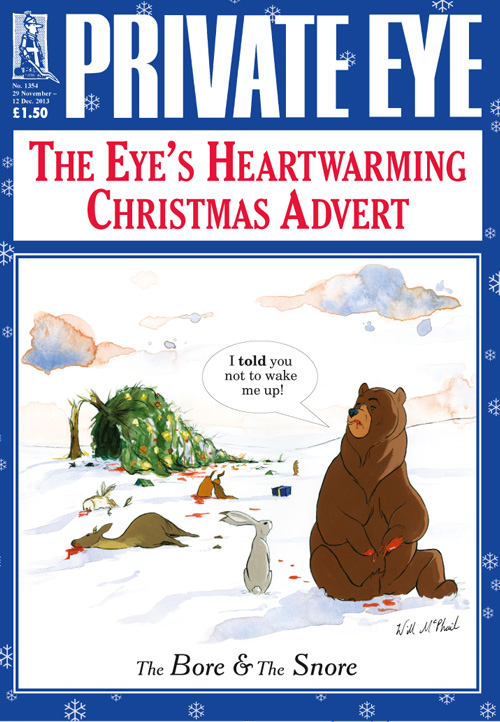
But there's a more important point here. Which has been shown with this year's advert.
This year, we get the complete package. A story that focuses on a young boy and an imaginary penguin (which is actually a stuffed toy). But the penguin is lonely, and wants another penguin to love. The kid buys another penguin for the penguin and presumably spent most of Christmas night banging them together, what with his limited understanding of how penguins procreate. I have to admit, I'm not entirely sure how penguins bang either, and have no desire to have that on my Google search history. Incidentally, since the kid's dad isn't in the advert, I'm entirely fine with the suggestion that the penguin toy is possessed by the ghost of the kid's dead dad.
But why is this important?
Because, similarly to the bear and hare, the penguin (Monty) has his own product range. You can buy plushies of Monty, t-shirts with Monty on, ties with Monty on, cushion covers with Monty on, duvet covers with Monty on. None of them are particularly cheap either.
As of last year, John Lewis moved from the advert being about their catalogue to being about a specific range of products. This is how successful they are. The main Monty items are already sold out, six weeks before Christmas. And in the reviews, someone is talking about how happy they are that they managed to get one, because they weren't able to buy their child the bear and the hare the previous year.
It's nakedly self-serving. It's pushing your emotional buttons in order to sell you a single, along with some plushie toys and duvet covers. They even went so far, this year, as to have the kid being given the plushie this year. It isn't even subtle.
It's part of a new trend, which I think Starbucks kicked off with their red cups. Corporate Christmas traditions. At least the red cups thing has finally backfired as just about every other coffee chain have realised that Starbucks don't own the colour red and have started doing the same thing at Christmas. Which means it's backfired a bit, which I'm delighted about.
But this is what adverts do. Cheaply and manipulatively try to take parts of Christmas and brand them.
And it works. We lap it up. The John Lewis advert has been an enormous hit, and what they're out to sell has sold out in the thousands.
But it's been beaten by the Sainsbury's advert, which retells the Christmas truce. This, for me, has crossed the line, and I think we need to talk about what's acceptable to use when you're manipulating people's emotions in the name of profit.
How did this come up in the first place? How did this idea first get floated and approved? I imagine the conversation in their PR team went a little like this:
"John, we need to come up with something to get more customers in the store, ever since we accidentally told everyone that we were trying to squeeze an extra fifty pence out of them."
"It's a tough one. Coming up with sentimental Christmas stuff isn't easy."
"Too true. I've heard that John Lewis are going with a lonely, blue-balled imaginary penguin."
"They must be completely out of ideas."
"I totally agree."
"If only we could use something truly touching."
"You mean like the Christmas truce in the first world war?"
"Yeah, something like that. A moment of humanity in the middle of a senseless war that caused so many millions of deaths. A moment that shows how we're all the same, even at our worst moments."
"So how do we take something like that and use it to make people spend money in our shop?"
"Steve, you don't think that could be a bit unpleasant, do you?"
"You're right. We'll leave out the death bit. Chuck in a robin. And give the Royal Legion a call so we can make out we're doing it out of Christmas spirit."
"Happy December Profits, John!"
I may be abridging it slightly, but I honestly think the conversation must have been at least a bit like that. Somewhere, some people around a table decided that the WWI Christmas truce was an appropriate point in history to exploit for an advert and they made sure there was a charity angle in there in case they were criticised. This will have been proposed, approved, written, tweaked, designed, tweaked, retweaked and finally given the green light to be filmed.
Fine, the profits from the chocolate bar go to the Royal Legion. That's a good thing. But let's not pretend it's being done purely out of charitable impulse. It's about increasing footfall. It's about getting people into the shop and getting them to buy more things than that single item.
That's why the advert exists. That's the point of it. That's the point of the chocolate bar.
This hasn't been done out of any cosy Christmas feelings. This has been done to exploit cosy Christmas feelings. Personally, I love Christmas, even as an atheist. I tend to go to Ireland and spend time with my family. I'm even into corny sentimentality - you're looking at one of the few people who liked the remake of Christmas on 34th Street. But I'm not into serious attempts to get me into your fucking shop.
What John Lewis have started with their mini Christmas movies is an attempt to corporatise a season. And it's become competitive. Everyone will, next year, be looking to see what Sainsbury's do, and if you think that all the other brands haven't noticed the press that John Lewis and Sainsbury's have had over these two mini-movies, then you'll be surprised just how many go for the emotion button next year, and what they're willing to do in order to achieve it.
If we're okay with an incident in the middle of the deaths of millions being used to get us into shops, then what are we not okay with?
Subscribe to:
Posts (Atom)